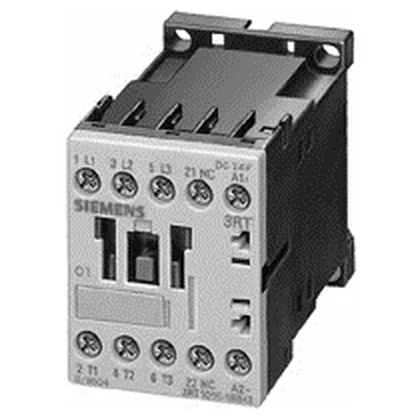
It carries a 24 VDC coil rated at 10 A for the main current circuit, meaning it switches resistive or light inductive loads up to that current at 24 V. For motor duty, the AC-2 rating at 400 V delivers 5.5 kW, so it handles standard three-phase induction motors up to that power in normal starting and running conditions. The AC-4 rating of 8.5 A at 400 V covers reversing or inching duty where the contactor makes and breaks the motor at full load — a tougher cycle that demands the lower current limit.
The 45 mm width and 60 mm height fit a single-module slot; the 73 mm depth leaves room for wiring behind the rail. Spring-loaded terminals on the main circuit accept 2x (0.25 to 2.5 mm²) solid or stranded, or 2x (24 to 14 AWG). Side-by-side mounting is allowed with 6 mm spacing, so you can gang several contactors on the same rail without derating, as long as the ambient stays within -25 to +60 °C during operation.
For Type 2 coordination (minimal damage after a short circuit), the required upstream fuse is a gL/gG 20 A. The auxiliary contact block (1 N/O instantaneous) handles control-circuit switching at various voltages: 10 A at 24 V, 6 A at 230 V, 3 A at 400 V, and 0.3 A at 220 V DC — enough for PLC inputs or relay coils in the same panel.