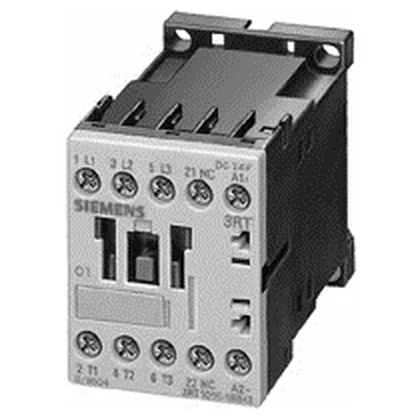
Terminals and wiring — field-serviceable
Both main and auxiliary/control circuits use spring-loaded terminals. That means no screwdriver torque check, no vibration loosening — just strip, push, and go. The main contacts accept 2x (0.25 to 2.5 mm²) solid or stranded, or 2x (24 to 14 AWG). Auxiliary contacts take the same gauge range. If you're replacing a screw-terminal contactor, the spring cage is a nice upgrade for reliability in a high-vibration panel.
Ratings that matter for motor control
AC-4 at 8.5 A handles the high-stress inching and plugging duty where the contacts take the full locked-rotor current. The auxiliary contacts are rated for 10 A at 24 V, 2 A at 60 V, 1 A at 110 V, 0.3 A at 220 V, and 6 A at 230 V — enough for most PLC or relay interface circuits.
Coordination and environment
Type 2 coordination (no welding after a short circuit) requires a 20 A gL/gG fuse; Type 1 (allow welding, but no fire risk) takes a 35 A fuse. That's a standard selection — your panel designer likely already has those on the BOM. Pollution degree 3 means it's suitable for conductive environments like a typical control room or light industrial floor.