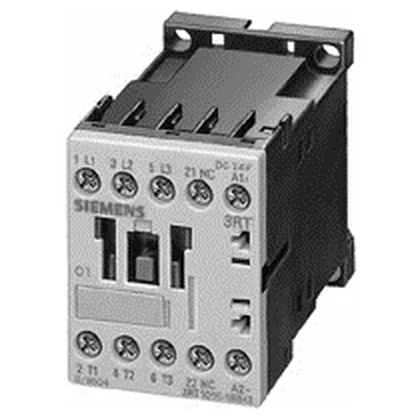
What this contactor is and what it handles
Its AC-4 rating at 400 V of 8.5 A is the figure that governs severe-duty applications like plugging, inching, or reversing — the switching events that wear contacts fastest, so that 8.5 A is the limit for those cycles, not the continuous thermal current.
Mounting and wiring — panel fit
Side-by-side mounting is permitted, meaning adjacent contactors can sit flush without a mandatory air gap, which simplifies multi-contactor groupings in tight enclosures. Main circuit wiring uses spring-loaded terminals accepting 2x (0.25 to 2.5 mm²) solid or stranded, or 2x (24 to 14 AWG). The spring-cage style reduces installation time compared to screw terminals — no torque check needed — and holds well under vibration.
Short-circuit coordination and protection
For Type 1 coordination (contactor may need replacement after a fault, but no hazard) the fuse rating goes up to 35 A gL/gG. These values matter when designing a panel to a specific SCCR — the fuse size directly determines the let-through energy the contactor must survive.
Environmental and operational limits
Altitude limit is 2,000 m; above that, dielectric strength and air-gap clearance derate, so for high-altitude installations (mines, mountain sites) the 2,000 m ceiling is a hard stop without re-rating the panel. Front face carries IP20 — finger-safe but not sealed against liquids, so keep it out of washdown zones.