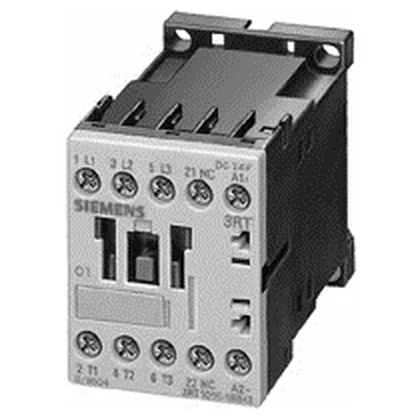
Rated for 400 V at 50 Hz, it carries motor ratings of 5.5 kW at both 500 V and 690 V under AC-2 duty, and 8.5 A at 400 V under AC-4 duty — the AC-4 figure governs the reversing or inching cycles where the contactor makes and breaks the motor current under load. For resistive loads (AC-12), the maximum operating current is 10 A. The main current circuit uses spring-loaded terminals, accepting 2x (0.25 to 2.5 mm²) solid or stranded wire, or 2x (24 to 14 AWG). This means no screw-torque check during commissioning — just strip to 8 mm and push in.
Side-by-side mounting is permitted, with only 6 mm clearance needed at the side, which lets you pack multiple contactors in a row without wasting panel width. That makes it suitable for industrial environments like machine tools, conveyor lines, and pump stations where the panel isn't climate-controlled. The auxiliary contact ratings cover the common control voltages: 10 A at 24 V, 6 A at 230 V, 3 A at 400 V, and 0.3 A at 220 V DC. The 24 V rating is the one most often used for PLC outputs — it handles the inrush of multiple contactor coils downstream.
These are the fuse ratings to put on your BOM if you're designing the motor branch circuit. Electrical life will be lower and depends on the switching category and current, but 30 million cycles means the mechanism outlasts most panel rebuild cycles.