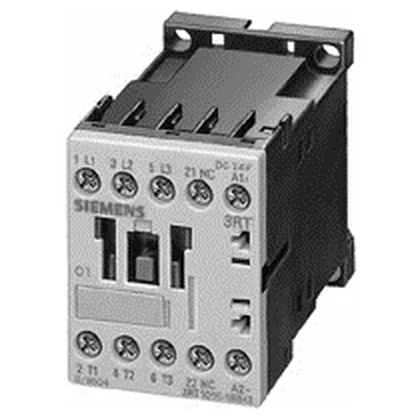
The Siemens 3RT1017-2BF41 is a SIRIUS power contactor in the size S00 frame — the smallest of the SIRIUS contactor family, built for motor starting and switching loads up to 5.5 kW in AC-3 duty at 500 V or 690 V.
Terminals and wiring
Main current circuit terminals are spring-loaded, accepting 2x (0.25 to 2.5 mm²) solid or stranded wire, or 2x (24 to 14 AWG). That's the same cage-clamp style you find on many PLC I/O modules — strip to 8 mm, push the wire in, no screw tightening.
The AC-3 rating is the one that matters for standard squirrel-cage motors: 5.5 kW at 500 V and the same 5.5 kW at 690 V. That tells you it can handle the inrush and break the running current of a motor up to that power. The auxiliary contact is a single instantaneous contact (1 NO or 1 NC depending on configuration), which is enough for a basic interlock or status feedback but may need an auxiliary contact block if you need more.
This matters for panel builders who need to meet IEC 60947-4-1 coordination requirements — pick your fuse size based on whether you want to protect the contactor or just clear the fault.