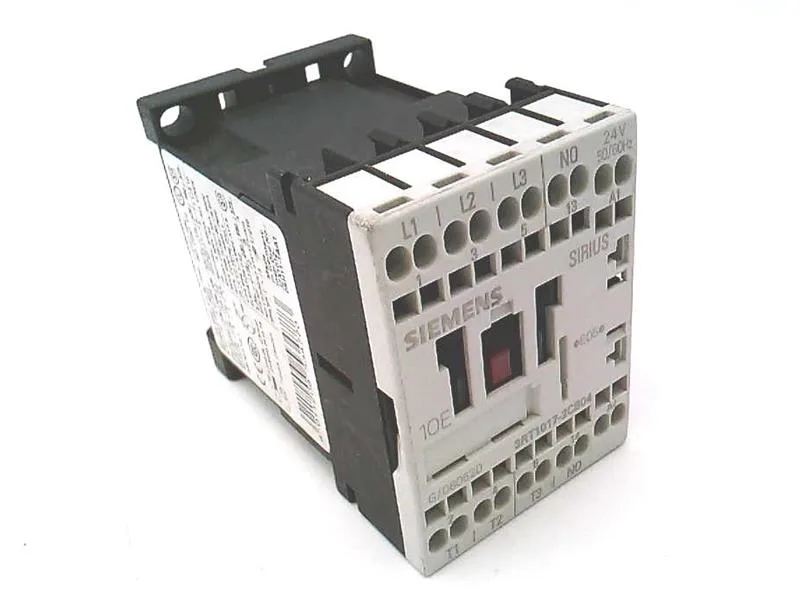
The 45 mm width and 60 mm height keep it tight in a crowded enclosure. The coil is wound for 24 VAC at 50/60 Hz, which is the standard control voltage across European and much of Asian panel design. The built-in varistor surge suppressor clips the inductive kick when the coil drops out — saves adding an external snubber on the PLC output card.
The headline motor ratings are 5.5 kW at 400 V AC-2 duty and 5.5 kW at 690 V — that's the three-phase induction motor load it handles in normal starting and running. For AC-4 reversing or plugging duty, the rated current drops to 8.5 A at 400 V, so if you're jogging or stopping a motor under load, that's the number to size against, not the AC-2 figure. For resistive or general-purpose loads (AC-12), the contactor carries 10 A maximum. The auxiliary contact block is rated for 10 A at 24 V, 6 A at 230 V, and 0.3 A at 220 V — watch the DC switching limits if you're breaking inductive DC loads on the aux contacts; the 24 VDC rating is 10 A, but at 60 VDC it's 2 A and at 110 VDC it's 1 A. Spring-loaded terminals on the main circuit accept 2x (0.25 to 2.5 mm²) solid or stranded, or 2x (24 to 14 AWG). That's a typical control-panel wire range — no need for ferrules on solid wire, but stranded should be ferruled for reliable clamping. The terminals are IP20 finger-safe, so the panel can stay live during troubleshooting with the door open.
That's a standard NH or D-type fuse — any major fuse line (Siba, Bussmann, ETI) will work.
Side-by-side mounting is allowed with zero spacing — the 45 mm width per pole is the installed width. Depth is 114 mm, which includes the coil terminals and the built-in varistor module; leave clearance for the spring-loaded terminal levers to open fully during wiring. Electrical life depends on the load current and switching frequency; for a pump or fan starting once per minute, you'll get millions of cycles before contact wear becomes an issue.