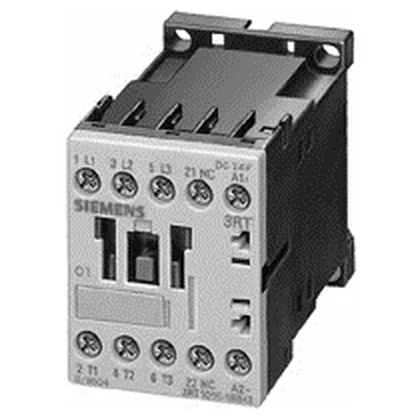
It integrates diode assemblies for surge suppression right in the coil circuit, so you don't need an external flyback diode across the coil terminals — saves a component and a wiring step on the panel. Spring-loaded terminals on the main current circuit accept 2x (0.25 to 2.5 mm²) solid or stranded conductors, or 2x (24 to 14 AWG). That's a standard size for control wiring; no special ferrules or bootlace crimps required beyond what you'd normally use for a 24 VDC control loop. The 45 mm width and 60 mm height fit the S00 footprint — same envelope as the base SIRIUS contactor range, so it slots into an existing panel layout without re-spacing.
Rated operational current for AC-12 (resistive) duty is 10 A at 24 V. That's the ceiling for general-purpose switching — resistive loads like heaters or pilot lights. For motor duty, the AC-3 rating at 400 V is 5.5 kW, which is the figure that governs most induction-motor applications in a 400 V three-phase panel. Coil holds at 3.3 W DC, both closing and holding. No inrush spike to worry about on the 24 VDC supply — the diode suppression keeps the coil circuit clean and prevents voltage transients from coupling back into the control bus. Mechanical endurance is 30 million operating cycles typical. That's the contactor mechanism itself; electrical endurance under load will be lower and depends on the switching category. For a 24 VDC control circuit switching resistive loads, the mechanical figure is the relevant ceiling.
On a crowded DIN rail, you can pack S00 contactors tight without derating, as long as ambient stays within the -40 to +70 °C operating range. The IP20 front protection keeps fingers and tools out of the terminal area; the contactor itself isn't sealed for washdown, so keep it inside the enclosure. Above that, air density drops and dielectric strength falls off — the contactor can still function, but you'd need to reduce the rated current per the manufacturer's altitude correction factors.