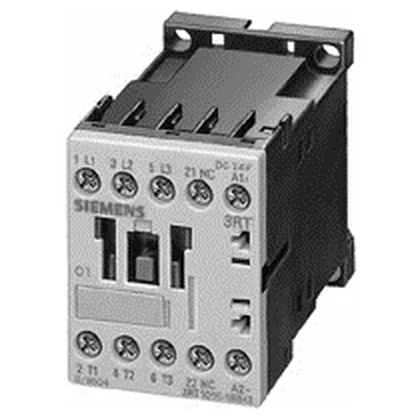
Its 24 VDC coil draws 1.4 W both on pickup and hold, so the control transformer can be sized for that continuous draw without a separate economizer circuit. The coil picks up at 85% of rated voltage and drops out at 185% — meaning it releases reliably on a sagging 24 V bus, which matters when you're sequencing multiple contactors off a shared supply.
The main contact ratings are given in AC-2 and AC-4 duty, which is what you need for slip-ring motor starting and plugging/inching respectively. At 400 V AC, it's rated for 5.5 kW in AC-2 and 8.5 A in AC-4. The AC-12 maximum operating current is 10 A — that's the resistive load ceiling, so for heater banks or ballast loads you're limited there. For motor power at higher voltages, it handles 5.5 kW at both 500 V and 690 V, meaning it's comfortable on 480 V and 600 V class systems without derating the power rating.
The 45 mm width means it takes a single 45 mm slot in the rail — panel fill factor is easy to calculate. The main circuit uses spring-loaded terminals accepting 2x (0.25 to 2.5 mm²) solid or stranded, or 2x (24 to 14 AWG). That's the same wire range as most terminal blocks in the panel, so you're not pulling odd wire sizes.
Environmental and protection
IP20 on the front and at the terminals — that's finger-safe but not washdown. The built-in varistor surge suppressor across the coil means you don't need to add a separate suppression diode or RC snubber — it's already there, handling the inductive kick when the coil de-energizes.