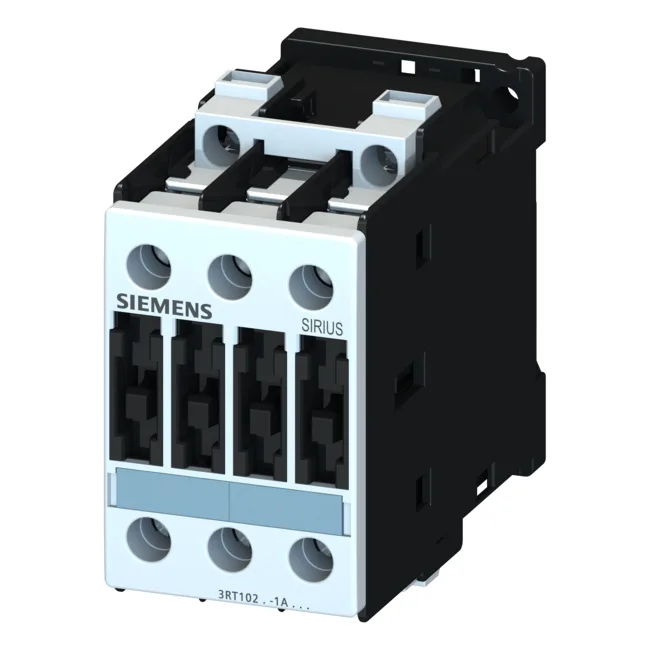
The 24 VAC coil accepts both 50 Hz and 60 Hz supplies, pulling in reliably across the 0.8–1.1x rated voltage range at 50 Hz and 0.85–1.1x at 60 Hz. Rated for AC-2 duty at 4 kW and AC-4 at 8.5 A, both at 400 V, this contactor handles reversing and plugging applications where the load current is interrupted under motor starting or braking conditions.
The auxiliary contact block carries a 10 A rating at 24 V, stepping down to 6 A at 230 V and 3 A at 400 V — enough for signaling back to a PLC input or holding a control relay. For motor loads, the main contacts are rated 4.5 kW at 500 V and 5.5 kW at 690 V, so it can switch a 5.5 kW motor on a 690 V line if the duty cycle stays within the AC-3 curve. Short-circuit coordination is specified: type 2 coordination requires a 25 A gL/gG fuse, while type 1 allows a 63 A gL/gG fuse. That tells the panel builder what upstream protection keeps the contactor operational after a fault (type 2) versus just preventing a fire (type 1).
Screw-type terminals on the main circuit accept 2x (1–2.5 mm²) solid or 2x (2.5–6 mm²) stranded, with a maximum of 2x 10 mm². The auxiliary terminals handle 2x (0.5–1.5 mm²) solid or 2x (0.75–2.5 mm²) stranded. Front protection is IP20 — safe for finger contact inside an enclosure — while the terminal area is IP00, meaning the live parts are exposed and the panel door must be interlocked or tool-accessed. The 24 VAC coil draws about 10 A inrush at pickup, settling to a lower holding current — verify the control transformer is sized for the inrush if multiple contactors pick up simultaneously.