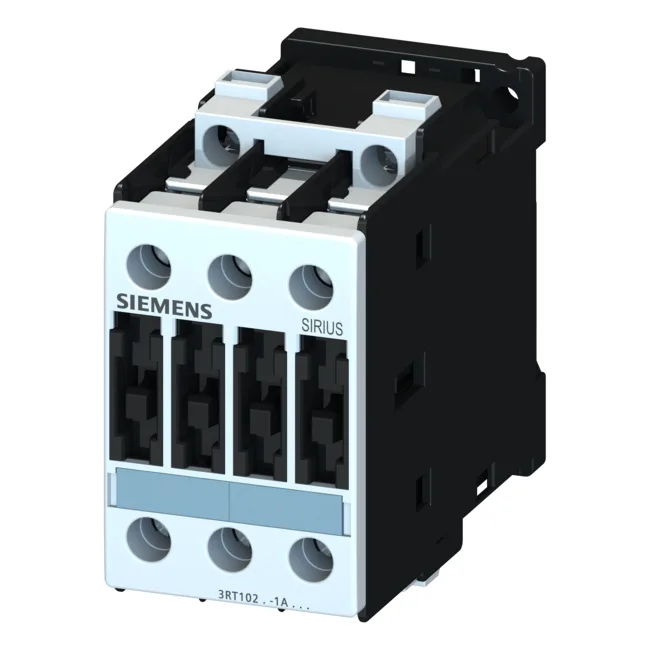
It carries a 110 V 50/60 Hz coil and uses screw-type terminals for both the main and auxiliary circuits. Motor power ratings land at 4.5 kW at 500 V and 5.5 kW at 690 V. In AC-4 duty (frequent inching/plugging), it's rated 8.5 A at 400 V — that's the number to watch for high-cycle reversing or jogging applications. The coil pulls in reliably across 0.8 to 1.1 times rated voltage at 50 Hz and 0.85 to 1.1 at 60 Hz. That's a standard hold-in range; expect dropout below the lower threshold.
Width is 45 mm, height 85 mm, depth 91 mm. Main terminals accept 2x (0.5 to 1.5 mm²) solid or 2x (0.75 to 2.5 mm²) stranded, max 2x 4 mm². For heavier feeds, the stranded range goes up to 2x (1 to 2.5 mm²) and 2x (2.5 to 6 mm²), max 2x 10 mm². AWG equivalents: 2x (16 to 12) solid, 2x (14 to 10) stranded, single 8 AWG. Auxiliary contacts take 2x (20 to 16) and 2x (18 to 14) AWG, single 12 AWG. Front protection is IP20; the terminal area is IP00. That means the contactor is safe from finger contact on the front but the terminals need enclosure protection — standard for open-panel mounting inside a cabinet.
Short-circuit coordination is specified: Type 2 requires a gL/gG 25 A fuse; Type 1 allows up to 63 A gL/gG. That's the selectivity data a panel builder needs for the upstream protection device.
The auxiliary contact block handles 10 A at 24 V, 2 A at 60 V, 1 A at 110 V, 0.3 A at 220 V, 6 A at 230 V, and 3 A at 400 V. These are the make/break ratings for control-circuit loads — useful for PLC inputs, pilot lights, or interposing relays.