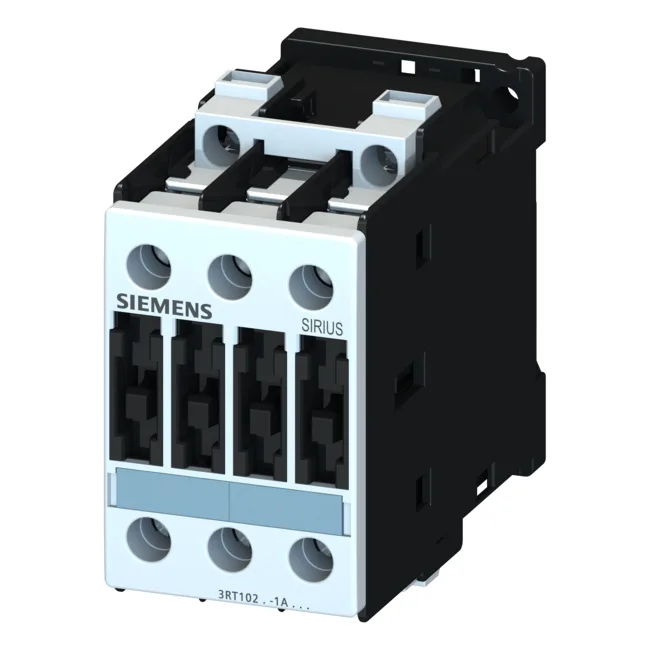
Rated for 4.5 kW at 500 V and 5.5 kW at 690 V, it handles the motor branch circuit for pumps, fans, and compressors up to those power levels. The 10 A rating at 24 V covers the control circuit pick-up, which is the coil inrush you need to budget for in the PLC output card. The AC-2 rating at 400 V is 4 kW, and the AC-4 rating at 400 V is 8.5 A — AC-4 is the heavy-duty plugging and inching duty cycle, so that 8.5 A figure is the one to watch if the application involves frequent reversing or jogging.
The S0 frame occupies 45 mm width, 85 mm height, and 91 mm depth on the DIN rail. Main circuit terminals are screw-type, accepting solid wire from 2x (0.5 to 1.5 mm²) up to max 2x (0.75 to 4 mm²), and stranded wire from 2x (1 to 2.5 mm²) up to max 2x 10 mm². AWG equivalents are 2x (16 to 12) solid and 2x (14 to 10) stranded, with a single 8 AWG maximum. This covers the typical motor branch wiring range without needing lug adapters. For short-circuit coordination, type 1 requires a 63 A gL/gG fuse; type 2 requires a 25 A gL/gG fuse. The type 2 value is the one to design to if you want the contactor to remain serviceable after a fault — that 25 A fuse limits the let-through energy so the contacts don't weld.
The AC-12 maximum operating current of 10 A applies to resistive loads — that's the auxiliary contact rating for signaling or pilot duty, not the main poles. The main pole ratings are the AC-2/AC-3/AC-4 figures above. Altitude limit is 2,000 m maximum without derating. Above that, the air density drop reduces the arc-quenching capability, so you'd need to apply a correction factor per IEC 60947. The coil operates at 50/60 Hz with a voltage tolerance of 0.8 to 1.1 times rated at 50 Hz and 0.85 to 1.1 at 60 Hz. That's a standard ±10% band for industrial contactors — fine for most plant supplies.