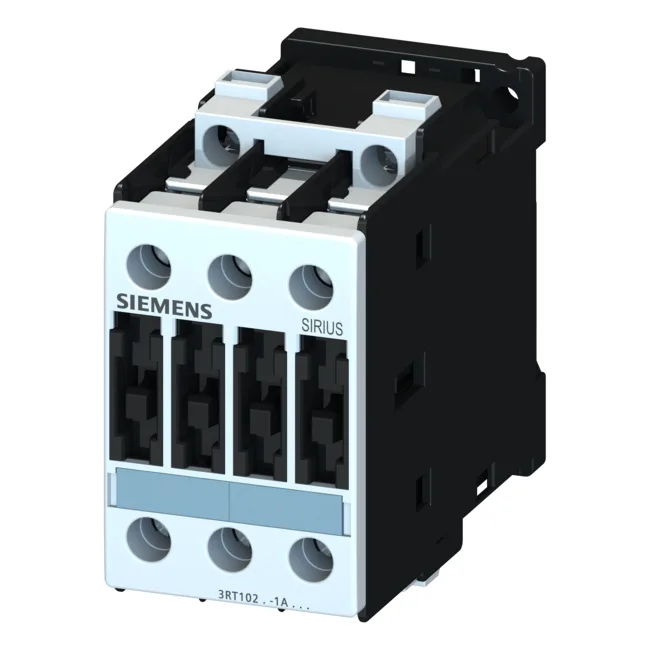
Its headline AC-4 rating of 8.5 A at 400 V governs the maximum motor inrush current during plugging or reversing duty — the real-world limit for frequent starts, not the AC-3 figure. For AC-2 duty (wound-rotor motors) it carries 4 kW at 400 V, and AC-12 (control-circuit resistive) goes to 10 A.
At 45 mm wide and 85 mm tall, the S0 frame fits tightly on DIN rail — six units per 270 mm section. Depth of 140 mm clears most standard gland plates. Screw-type terminals accept 2x (0.5...1.5 mm²) solid or 2x (0.75...2.5 mm²) stranded on the control side; main power terminals handle 2x (1...2.5 mm²) stranded up to 2x 10 mm² solid. AWG equivalents: 2x 16–12 stranded, 1x 8 solid for the main circuit. No special tools beyond a standard screwdriver needed.
Coordination and protection pairing
For Type 2 coordination (no weld risk after fault) Siemens specifies a gL/gG 25 A fuse upstream. Type 1 coordination (device may weld, but no fire or arc hazard) allows a 63 A gL/gG fuse. These values matter for SCCR compliance in UL 508A panels — the fuse limits let you calculate the available fault current the contactor can safely interrupt.