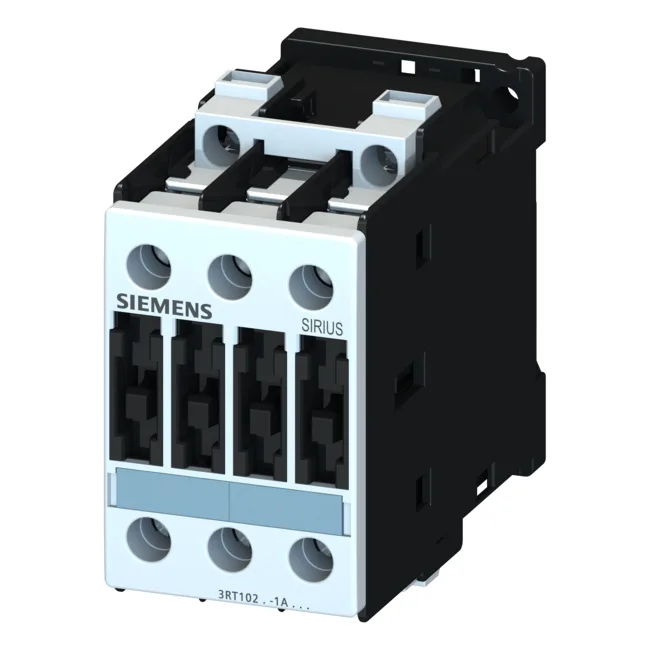
The Siemens 3RT1023-1AN64 is a SIRIUS power contactor in the Size S0 frame, built for switching three-phase motor loads up to 5.5 kW at 690 V in AC-3 duty. The coil is wound for 200 V at 50 Hz or 200-220 V at 60 Hz — a common control voltage in European-derived panels, so check your control transformer tap before wiring. Rated operating current hits 8.5 A in AC-4 duty at 400 V for reversing or inching applications, and 10 A max in AC-12 for resistive loads.
Side-by-side mounting is allowed with zero gap, but if you need airflow for high-duty cycling, leave the 6 mm side clearance the spec mentions. Main circuit terminals are screw-type, accepting 2x (1 to 2.5 mm²) solid or 2x (2.5 to 6 mm²) stranded, with a max of 2x 10 mm². Auxiliary contacts take 2x (0.5 to 1.5 mm²) solid or 2x (0.75 to 2.5 mm²) stranded. That's typical for a Size S0 — no special crimping tools needed, but torque to the Siemens spec on the nameplate.
Short-circuit coordination and protection
If you're building to IEC 60947-4-1, the Type 2 limit is the one that keeps the contactor reusable after a bolted fault.
Auxiliary contact block
Comes with 2 instantaneous auxiliary contacts (1 NO + 1 NC by default on this variant). Ratings span 10 A at 24 V, 6 A at 230 V, 3 A at 400 V, and 0.3 A at 220 V DC — enough for PLC inputs or relay coils in the same panel. The DC rating drops fast with voltage, so don't try switching a 220 V DC solenoid without checking the make/break curve.