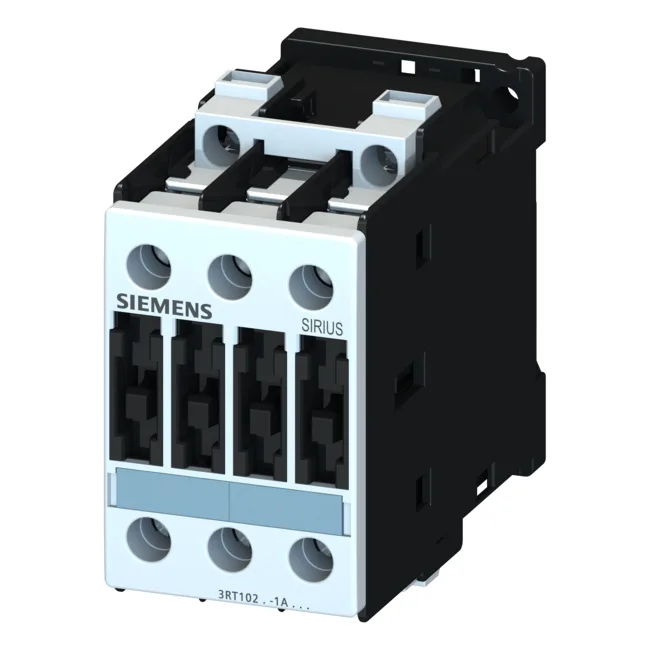
Siemens SIRIUS 3RT1023-1AP64 Power Contactor — Integrator's Note
Rated for a 4.5 kW motor at 500 V (50 Hz) and 5.5 kW at 690 V (60 Hz), this contactor covers common European and North American line voltages. Coil rated for 220 V at 50 Hz and 240 V at 60 Hz, operating range 0.8 to 1.1 times rated voltage at both frequencies. Front protection is IP20 (finger-safe), but the terminals themselves are only IP00 — so the panel enclosure provides the touch protection at the wiring points.
Panel Fit & Wiring — What the Specs Mean for the Build
At 45 mm wide, 85 mm tall, and 140 mm deep, the S0 frame fits a standard 45 mm DIN-rail slot. Main circuit terminals are screw-type, accepting solid or stranded wire: 2x (0.5 to 1.5 mm²), 2x (0.75 to 2.5 mm²), or max 2x (0.75 to 4 mm²). That covers most motor feeds up to 5.5 kW without needing a lug adapter. The contactor carries two instantaneous auxiliary contacts for feedback or interlocking. For type 2 coordination (no weld under fault), use a gL/gG fuse rated at 25 A. For type 1 coordination (welding allowed, but no fire risk), the fuse can go up to 63 A. This lets the panel designer choose between protecting the contactor or protecting the downstream circuit, depending on the application criticality.
Duty Ratings — AC-2, AC-4, and DC Switching
That is a lower stress than AC-4, so the electrical life will be longer in that application. For AC-4 at 400 V, the 8.5 A rating is the limiting factor — do not exceed it on reversing or plugging duty. DC switching capability is provided for the auxiliary contacts: 10 A at 24 V, 2 A at 60 V, 1 A at 110 V, and 0.3 A at 220 V. These are resistive load ratings (DC-12/13 typical). If you are switching an inductive DC load like a brake coil, derate further or add a free-wheel diode. That is the mechanical endurance of the contactor frame and armature, not the electrical life under load — electrical life will be lower depending on the switching current and duty cycle.