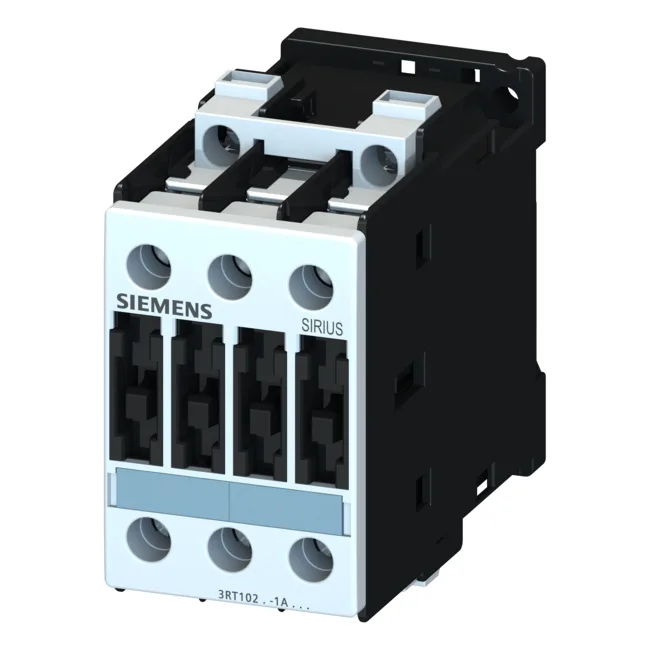
Rated 10 A in AC-12 duty, this contactor handles resistive and solid-state loads at that current. For motor switching, the AC-2 rating at 400 V is 4 kW, and the AC-4 rating at 400 V is 8.5 A — the AC-4 figure governs reversing and inching applications where the contactor makes and breaks motor current under load. The coil draws 5.4 W closing and 5.4 W holding at DC, so the holding power is the same as the inrush — no power drop after pickup. That simplifies the control transformer sizing: budget a steady 5.4 W per contactor.
For standard squirrel-cage motors, the AC-3 rating (not listed here) would normally apply, but the AC-2 and AC-4 ratings give you the real switching capability for the duty cycles that stress the contacts hardest. At 500 V the motor rating is 4.5 kW, and at 690 V it is 5.5 kW — the contactor can handle higher-voltage motors up to those power levels, useful in 690 V distribution systems common in mining or marine installations.
Screw-type terminals for the main current circuit accept 2x (0.25 to 2.5 mm²) solid, 2x (1 to 2.5 mm²) stranded, 2x (2.5 to 6 mm²) stranded, and up to 2x 10 mm² or 1x 8 AWG. That covers most panel wiring from control to power feeders. This lets the panel designer choose between protecting the contactor or minimizing upstream fuse size.
The S0 frame size is a common Siemens SIRIUS footprint, so panel layouts using this contactor are stable across the product line. If you need a different coil voltage or auxiliary contact configuration, other S0 variants exist within the 3RT1023 family, but the 3RT1023-3BD40 is the specific order code for this 24 V DC coil variant with screw terminals.