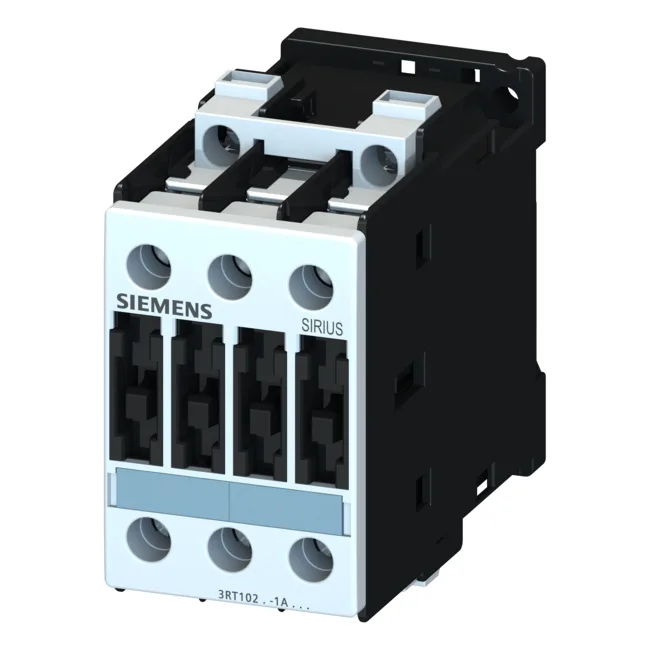
It delivers 4.5 kW at 400 V under AC-3 (cites:) and 5.5 kW at 690 V (cites:), making it a fit for three-phase induction motors in that power band. The 24 VDC coil draws 5.4 W both for closing and holding (cites:,), so the control transformer and power supply need to cover that inrush — it's a constant-gap magnet design, not a latching type.
The AC-3 rating at 400 V (4.5 kW) is the one that governs most motor-start applications — that's the load-break rating for squirrel-cage motors under starting and running conditions. The AC-4 rating at 400 V (8.5 A) (cites:) covers plugging and inching duty, where the contactor opens under locked-rotor current; if your cycle includes frequent reversals or jogging, that 8.5 A figure is the hard limit, not the AC-3 kW number. For purely resistive loads (AC-12), the maximum operating current is 10 A (cites:). Short-circuit coordination is specified: with Type 1 coordination, a gL/gG fuse up to 63 A is required (cites:); with Type 2 coordination, the fuse limit drops to 25 A (cites:). Type 2 means the contactor remains fit for further service after a fault — important for production lines where a blown contactor means downtime. The auxiliary contact block handles 10 A at 24 V (cites:), 6 A at 230 V (cites:), and 3 A at 400 V (cites:). Those are the thermal ratings for the N/O and N/C contacts.
Side-by-side mounting is allowed (cites:) with zero clearance between units — no derating for thermal stacking at rated current, but verify ambient temperature inside the enclosure. Main circuit terminals accept screw-type connections: 2x (1 to 2.5 mm²), 2x (2.5 to 6 mm²), or max 2x 10 mm² (cites:). AWG equivalents are 2x (16 to 12), 2x (14 to 10), or 1x 8 (cites:). The depth is 100 mm (cites:), width 45 mm (cites:), height 85 mm (cites:). Side clearance of 6 mm is needed for wiring access (cites:). Maximum operating altitude is 2000 m (cites:) — above that, derate for air density.