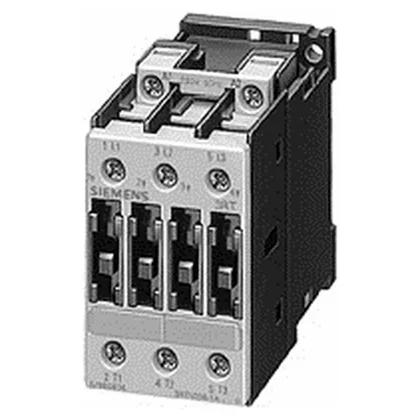
The 3RT1024-1AC20: Coil is 24 V, rated for both 50 Hz and 60 Hz, with an operating range of 0.8 to 1.1 times the rated voltage. That's a standard tolerance — your 24 V control transformer needs to stay above 19.2 V under load to guarantee pick-up. For AC-4 at 400 V, the rated operational current is 12.5 A, which covers plugging and inching duty cycles on squirrel-cage motors. If your application is standard AC-3 direct-on-line starting, the 7.5 kW ratings at 500 V and 690 V give you the headroom for higher-voltage motor circuits.
This contactor is specified with two coordination levels. That's a meaningful difference in selectivity — if you're coordinating with a motor protection breaker rather than fuses, confirm the let-through energy of your MCCB or manual motor starter stays within the contactor's withstand. Pollution degree 3 rating means it's suited for the typical industrial control panel environment where conductive pollution can occur.
Wiring and endurance
Both main and auxiliary circuits use screw-type terminals. Main contacts accept 2x (0.5 to 1.5 mm²), 2x (0.75 to 2.5 mm²), or max 2x (0.75 to 4 mm²) solid or stranded — that covers standard motor cable up to 4 mm². AWG equivalents: main 2x (16 to 12), 2x (14 to 10), 1x 8; auxiliary 2x (20 to 16), 2x (18 to 14), 1x 12. Mechanical endurance is 10 million cycles typical — that's the life of the contactor mechanism without contact wear. Electrical endurance depends on the switching category and load current; for AC-3 duty at rated current, expect roughly 1 to 2 million operations before contact inspection is needed.
RoHS compliance date is 01 July 2006 — the part meets the original EU RoHS directive. It carries the IEC 81346-2 reference code Q, which designates it as a switching device in the plant documentation system.