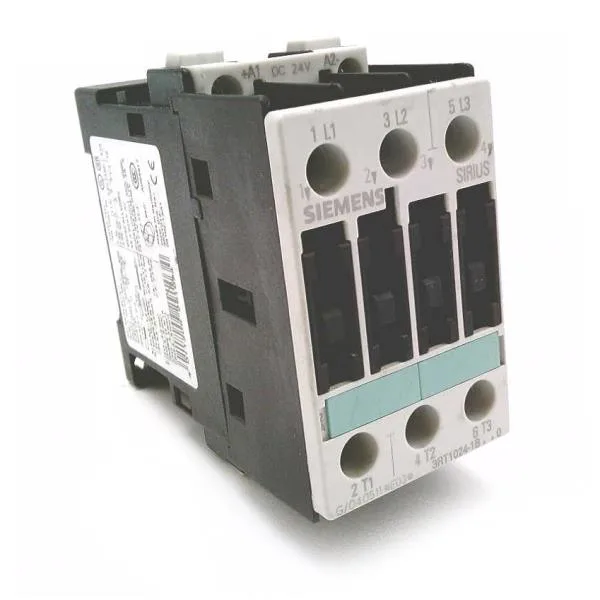
The main contacts are screw-type terminals sized for 2x (1...2.5 mm²) stranded or 2x (2.5...6 mm²) solid, with a max of 2x 10 mm² — typical for panel wiring in this frame size. Mounting is screw or snap-on onto 35 mm DIN rail per EN 50022, and the 45 mm width means it fits standard S0 spacing — three units side-by-side fill a 135 mm section.
Rated for 7.5 kW at both 500 V and 690 V, this contactor handles motor loads up to that power in AC-3 duty (standard squirrel-cage motors). At 400 V AC-2 duty (slip-ring motors, wound-rotor), it's rated 5.5 kW. For AC-4 duty (plugging, inching, reversing) at 400 V, the continuous current rating is 12.5 A — that's the number to watch for high-stress reversing applications, not the AC-3 figure. The auxiliary contact block carries 2 instantaneous contacts, configurable as NO/NC depending on the block ordered separately.
For Type 2 coordination (contactor remains usable after a fault), the fuse drops to gL/gG 25 A. This matters when you're specifying the MCCB or fuse downstream — use the 25 A limit if you want to avoid replacing the contactor after a fault.