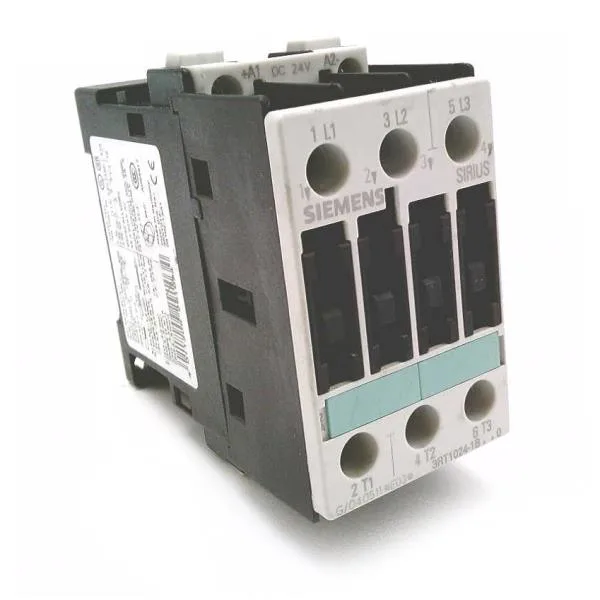
Rated for AC-3 duty at 7.5 kW on both 500 V and 690 V supplies, this contactor handles the motor starting and stopping that drives pumps, conveyors, and compressors in industrial lines. The 45 mm width and 85 mm height keep it compact for dense panel builds. Front-side protection is IP20, so it's safe for finger contact inside an enclosure; the terminals themselves are IP00, meaning the wiring compartment expects enclosure protection from the panel builder.
The AC-4 rating of 12.5 A at 400 V is the one that governs frequent inching or plugging duty — if your application cycles the motor on and off under load, this is the current limit that matters, not the higher AC-3 figure. Auxiliary contact ratings cover 24 V at 10 A down to 220 V at 0.3 A, so the same block handles both PLC-level signals and small relay loads without a separate interface.
Main and auxiliary circuits use screw-type terminals. Main terminals accept 2x (0.5 to 1.5 mm²), 2x (0.75 to 2.5 mm²), or max 2x (0.75 to 4 mm²) solid or stranded — that covers most panel wire sizes up to 4 mm². Auxiliary terminals take 2x (1 to 2.5 mm²) solid or stranded, or max 2x 10 mm². For Type 2 coordination (no-weld fault clearing), the required upstream fuse is 25 A gL/gG. For Type 1 coordination (device may be damaged but arc contained), the fuse can go up to 63 A gL/gG. This matters when you're coordinating with the MCCB or fuse in the feeder.
Substance prohibition per RoHS applies from July 1, 2006, so the part is RoHS-compliant for EU and most global markets. The IEC 81346-2 reference code is Q, which designates it as a switching device in the plant documentation standard.