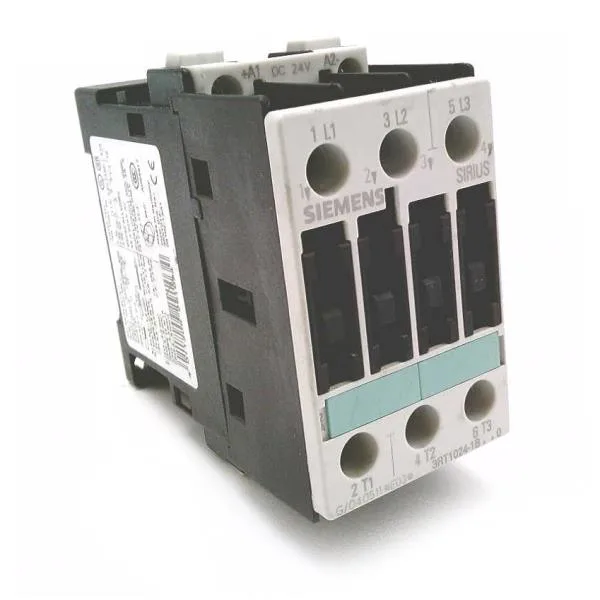
SIRIUS S0 power contactor — 3 NO, 7.5 kW, screw terminals
The Siemens 3RT1024-1AL00 is a SIRIUS S0-frame power contactor with three normally-open main contacts, rated for motor switching at 7.5 kW on both 500 V and 690 V AC-3 duty. That 7.5 kW at 690 V means it handles a 3-phase induction motor pulling about 9 A per phase at that voltage — common for European 690 V distribution in heavy industrial plants. Screw-type terminals on the main circuit accept 2x (1 to 2.5 mm²) solid or stranded, with a max of 2x 10 mm² — enough for the motor leads on a 7.5 kW load. Control circuit terminals take 2x (0.5 to 1.5 mm²) solid, 2x (0.75 to 2.5 mm²) stranded.
If your application does frequent reversing or jogging, that 12.5 A figure governs contact life, not the AC-3 motor rating. For type 2 coordination (no weld under fault), Siemens specifies a 25 A gL/gG fuse upstream. Type 1 coordination (welding allowed but no fire hazard) takes a 63 A fuse. That tells you the short-circuit withstand capability: the contactor can clear a fault up to the fuse's interrupting rating without catastrophic failure. The auxiliary contact ratings cover a range of control voltages: 10 A at 24 V, 6 A at 230 V, 3 A at 400 V, 0.3 A at 220 V DC. The DC switching capability drops fast with voltage — at 220 V DC it's only 0.3 A, so verify your DC control circuit load against the curve.