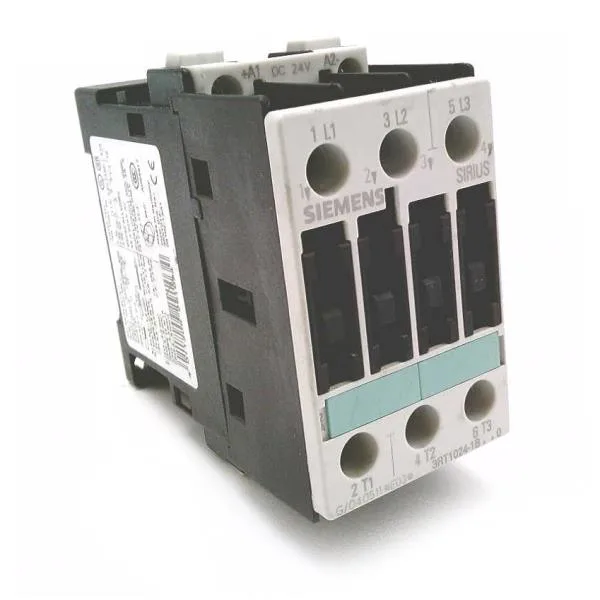
At 45 mm wide and 85 mm tall, it fits the S0 footprint — a common size for motor loads up to 7.5 kW at 400 V AC.
Rated for AC-2 duty at 400 V at 5.5 kW and AC-4 at 400 V at 12.5 A, this contactor handles reversing or plugging applications where the motor sees frequent starts and stops — AC-4 covers the severe switching duty that wears contacts faster than a simple on-off load. At 690 V it still delivers 7.5 kW, so it works on 400 V and 690 V systems without derating the motor power. The coil holds at 0.8 to 1.1 times rated voltage at 50 Hz — meaning it pulls in reliably even if the line dips to 184 V AC. The auxiliary contact block (not included) carries 10 A at 24 V AC, 6 A at 230 V AC, and 3 A at 400 V AC — enough for a PLC input or a pilot lamp. For DC switching, it handles 10 A at 24 V, 2 A at 60 V, and 0.3 A at 220 V.
Terminal specs and wiring
Main circuit terminals are screw-type, accepting 2x (1 to 2.5 mm²) solid or 2x (2.5 to 6 mm²) stranded, with a maximum of 2x 10 mm². The auxiliary terminals take 2x (0.5 to 1.5 mm²) solid or 2x (0.75 to 2.5 mm²) stranded, max 2x 4 mm². That covers most panel wiring up to 10 AWG for the main power and 14 AWG for control circuits. That matters when you're sizing the branch circuit protection — pick the fuse class based on whether you can tolerate a welded contactor in a fault.
The front is IP20, the terminals are IP00 (finger-safe only with the enclosure door closed). Most plants are below that, but check if your site is in the mountains.