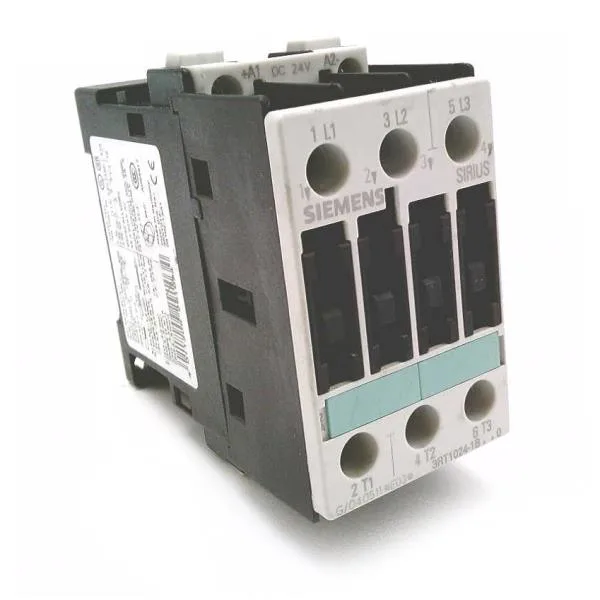
The Siemens 3RT1024-1BD40 is a SIRIUS power contactor in the Size S0 frame, rated for motor switching up to 7.5 kW at 500 V or 690 V, and 5.5 kW at 400 V in AC-2 duty. The 24 VDC coil draws 5.4 W on closing and holding — a single-supply DC coil that simplifies control wiring in panels with a 24 VDC bus. The contactor mounts via screw or snap-on onto 35 mm DIN rail per DIN EN 50022, and the screw-type terminals accept solid conductors from 0.5 to 4 mm² (2x per clamp) or stranded up to 10 mm².
The headline AC-12 rating of 10 A is the general-purpose resistive load current — useful for panel heaters or lighting contactor duty, but not the motor-switching number. The 24 VDC coil is a standard industrial voltage; the 5.4 W holding power means the coil runs cool and the power supply doesn't need a large margin for this one device. For short-circuit protection, Type 1 coordination requires a 63 A gL/gG fuse; Type 2 coordination (for reduced damage after a fault) needs a 25 A gL/gG fuse.
The 45 mm width (3 modules wide) fits standard enclosure rail spacing. The screw terminals are accessible from the front; strip length for solid conductors is about 8–10 mm. For the main circuit, use the listed AWG equivalents: 2x 16–12 AWG solid, or 2x 14–10 AWG stranded, or 1x 8 AWG. The coil terminals accept the same range. No special tools beyond a screwdriver and wire stripper are needed.