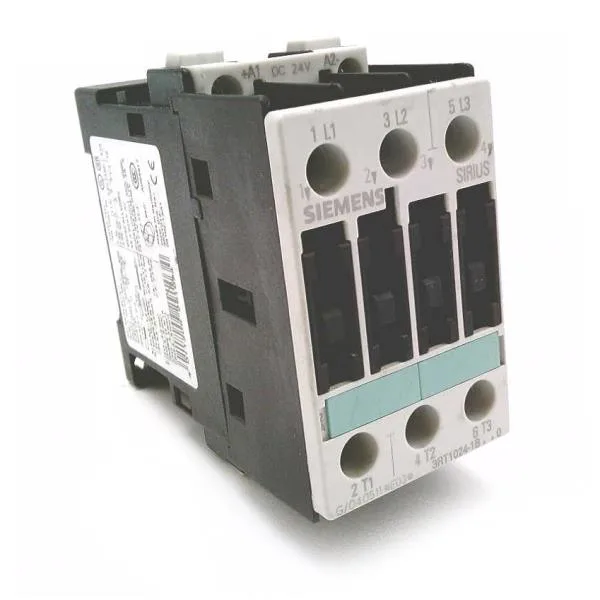
It carries a 7.5 kW motor rating at both 400 V and 690 V AC-3 duty, so it handles standard 400 V three-phase motors up to that power and also works at 690 V without derating the power rating — useful on 690 V line supplies common in mining or heavy industry. For reversing or plugging duty (AC-4), the contactor is rated 12.5 A at 400 V, which is the current it can interrupt under those higher-stress switching conditions. The S0 frame keeps the width to 45 mm, and the 85 mm height and 101 mm depth fit standard 35 mm DIN rail enclosures with side-by-side mounting permitted without derating.
Side-by-side mounting is allowed, with a 6 mm clearance specified at the side — no extra air gap needed between adjacent contactors of the same frame. Main circuit terminals accept solid/stranded copper: 2x (1 to 2.5 mm²), 2x (2.5 to 6 mm²), max 2x 10 mm², with AWG equivalents 2x (16 to 12), 2x (14 to 10), 1x 8. Auxiliary contact terminals are smaller: 2x (0.5 to 1.5 mm²), 2x (0.75 to 2.5 mm²), max 2x (0.75 to 4 mm²). Strip lengths follow standard screw-terminal practice — no special tooling needed.
For Type 2 coordination (contactor remains operable after a fault), the fuse drops to 25 A gL/gG. These are the manufacturer's specified maximums — the actual fuse size depends on the upstream breaker and cable rating, but these values set the coordination boundary.
Coil and auxiliary ratings
The magnet coil draws 5.4 W both for closing and holding (DC), so the coil power supply sees a constant load once picked up. Auxiliary contact switching capacity is rated at various voltages: 10 A at 24 V, 6 A at 230 V, 3 A at 400 V, 2 A at 60 V, 1 A at 110 V, and 0.3 A at 220 V — these are the maximums for the built-in auxiliary contacts, not the main poles.