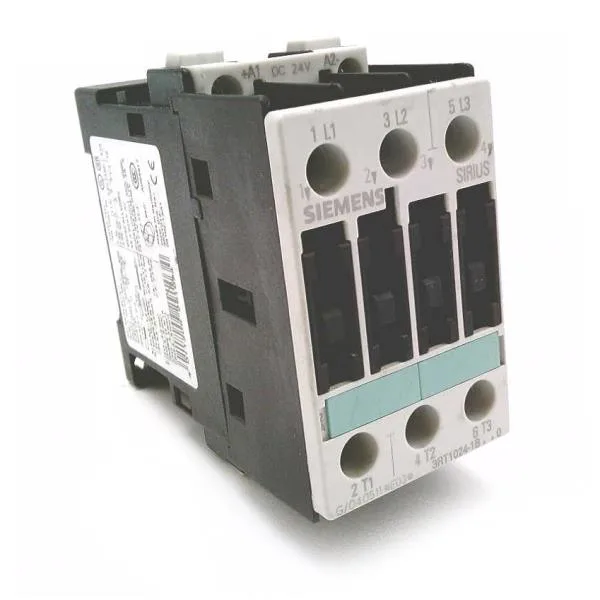
Siemens 3RT1024-1BE40 SIRIUS Power Contactor — Integrator's Spec Recap
The Siemens 3RT1024-1BE40 is a SIRIUS power contactor in the Size S0 frame, rated for motor switching up to 7.5 kW at both 500 V and 690 V. The 45 mm width and 85 mm height fit standard panel layouts; depth is 101 mm. AC-4 switching at 400 V is rated at 12.5 A — that's the severe-duty category for reversing or inching applications. For resistive loads (AC-12), the contactor handles 10 A continuous.
Mounting and Wiring — Panel OEM Checklist
The Size S0 footprint is a common panel slot; if you're swapping from another S0 frame contactor, the DIN rail holes and terminal layout should align without drilling. Main circuit terminals accept solid conductors: 2x 0.5–1.5 mm², 2x 0.75–2.5 mm², or max 2x 0.75–4 mm². For stranded wire: 2x 1–2.5 mm², 2x 2.5–6 mm², or max 2x 10 mm². AWG equivalents are 2x 16–12, 2x 14–10, or 1x 8. Strip length and torque values aren't in this spec line — pull the datasheet for those before terminating.
Coordination and Protection — Site Electrical Engineer Note
Maximum altitude is 2000 m without derating; above that, air density affects arc extinction and cooling.