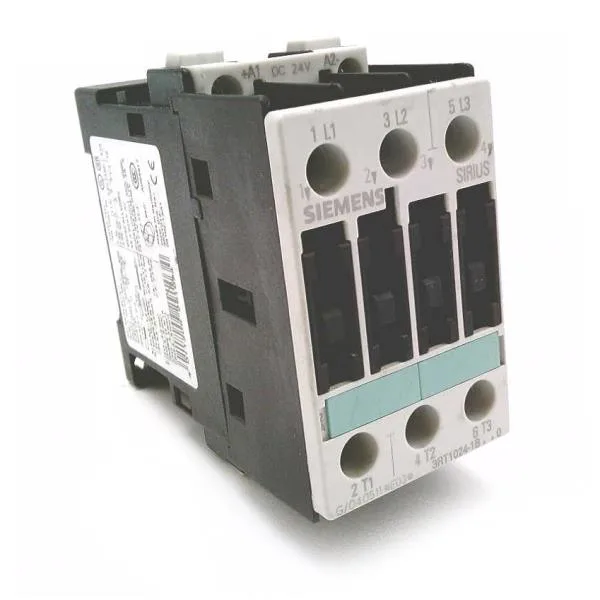
It handles 7.5 kW at 400 V in AC-3 duty and the same at 690 V, so it's sized for standard three-phase induction motors up to about 10 hp on a 400 V line. The 24 VDC coil draws 5.4 W both on pickup and hold, which simplifies the DC supply sizing in the panel — no inrush spike to budget for.
Where it fits — panel and mounting
The S0 footprint is 45 mm wide by 85 mm tall by 101 mm deep, so it takes up a single 45 mm slot on the rail — standard for this class. Side-by-side mounting is allowed with a 6 mm gap to the side, which keeps the row dense without derating.
The AC-3 rating at 400 V is 7.5 kW — that's the motor switching number that matters for most conveyor, pump, and fan applications. For auxiliary contacts, the 24 V rated value is 10 A, dropping to 2 A at 60 V, 1 A at 110 V, and 0.3 A at 220 V — these are the DC switching limits for the control circuit, so if you're feeding a PLC input, stay within these curves.
Wiring and protection
Main circuit terminals are screw-type, accepting 2x (0.5 to 1.5 mm²) solid, 2x (0.75 to 2.5 mm²) stranded, or up to 4 mm² max. For AWG, that's 2x (16 to 12) solid, 2x (14 to 10) stranded, or 1x 8. For short-circuit protection, Type 2 coordination requires a 25 A gL/gG fuse; Type 1 allows up to 63 A. This matters if the panel spec calls for Type 2 — you need the 25 A fuse limit to avoid damaging the contactor on a fault.