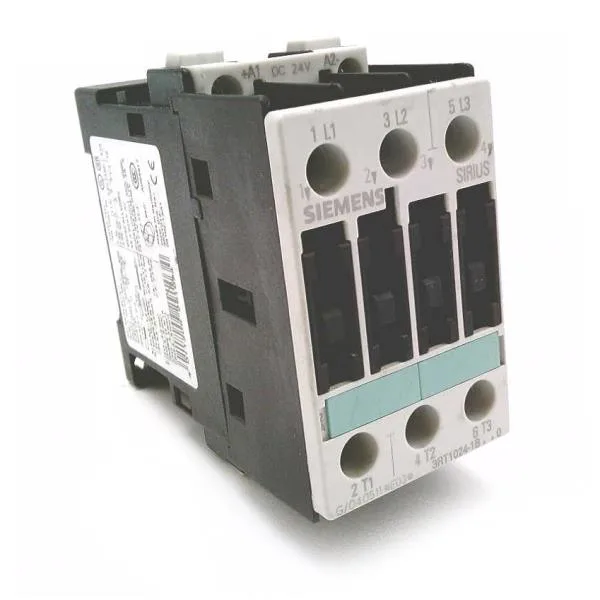
The Siemens 3RT1024-1BW44 is a SIRIUS power contactor in the Size S0 frame, designed for switching three-phase motor loads up to 7.5 kW at both 500 V and 690 V AC-3 duty. The contactor snaps onto a 35 mm DIN rail per EN 50022 and uses screw-type terminals for the main circuit, accepting up to 2x 10 mm² or 1x AWG 8 conductors.
The 45 mm width and 85 mm height on the Size S0 frame mean it occupies a single 45 mm module on the DIN rail — standard for a contactor this size, so it fits alongside a matching overload relay without overhanging the rail. Depth of 150 mm includes the coil terminals and arc chamber; allow clearance for the screwdriver swing when terminating. Side-by-side mounting is permitted with 6 mm spacing to adjacent devices, which keeps the panel layout dense but still serviceable. The DC coil draws a constant 5.4 W whether closing or holding, so the thermal load on the enclosure is predictable — no inrush spike to derate for. At 48 V, the pickup voltage is typically 0.8 x nominal (38.4 V), and dropout occurs around 0.1 x nominal (4.8 V), giving a wide hold-in range against dips on a DC bus. For DC switching applications, the 3RT1024-1BW44 is rated 10 A at 24 V, 2 A at 60 V, 1 A at 110 V, and 0.3 A at 220 V — these are resistive-load values (DC-1). If switching inductive DC loads, derate further or add a free-wheeling diode across the load; the contactor's own coil suppression is internal, but the main contacts need external protection.
Motor duty and coordination
At 400 V AC-3, the contactor switches motor loads up to 7.5 kW — the same power rating as at 500 V and 690 V, so the limiting factor is current, not voltage, above 400 V. For reversing or plugging duty (AC-4 at 400 V), the rated operational current is 12.5 A, which is about half the AC-3 current; this reflects the higher arc stress during inching and reversing cycles. Type 2 coordination requires a 25 A gL/gG fuse; Type 1 coordination allows a 63 A fuse, giving flexibility depending on whether downstream damage tolerance is acceptable.