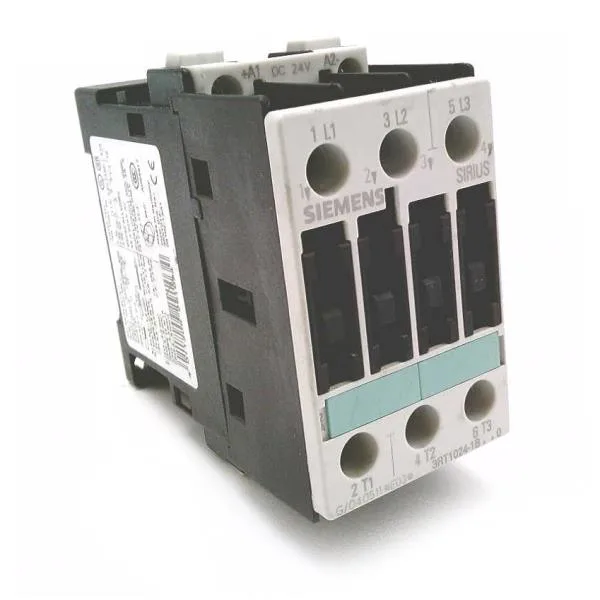
The coil draws 5.4 W on both pickup and hold, with a built-in varistor surge suppressor across the coil terminals — no external snubber needed for DC switching. Panel integration is straightforward: the S0 footprint is 45 mm wide, 88 mm tall, and 150 mm deep, with 6 mm clearance required at the side for side-by-side mounting.
The AC-4 rating of 12.5 A at 400 V governs plugging and inching duty — the hardest thermal cycle for a contactor because the motor is stalled during reversal. At 500 V and 690 V, the motor power rating holds at 7.5 kW — a useful headroom for 400 V motors on a 690 V line. The auxiliary contacts are rated for 10 A at 24 VDC, derating to 6 A at 230 V and 0.3 A at 220 VDC — typical for control-circuit switching. Type 2 coordination (fuse gL/gG: 25 A) and Type 1 coordination (fuse gL/gG: 63 A) are both specified, so the contactor integrates into existing selective-coordination schemes without re-engineering the upstream protection.
The main contact wiring accepts 2x (1.0–2.5 mm²), 2x (2.5–6 mm²), or max 2x 10 mm² solid/stranded, with AWG equivalents 2x (16–12), 2x (14–10), or 1x 8. The auxiliary/solid terminals accept 2x (0.5–1.5 mm²), 2x (0.75–2.5 mm²), or max 2x (0.75–4 mm²). Strip length and torque values follow standard SIRIUS practice — no special tooling required beyond a screwdriver and a ferrule crimper for stranded wire.