What it is and what it does
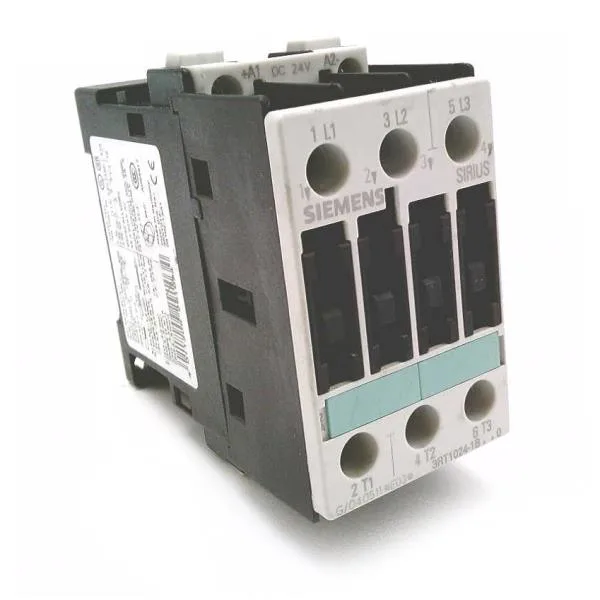
The Siemens 3RT1024-3BD40 is a SIRIUS power contactor in the S0 frame size, designed for switching motor loads in industrial control panels. It mounts via screw or snap-on onto 35 mm DIN rail per EN 50022, making it a straightforward swap in existing panel layouts. Rated for AC-2 duty at 5.5 kW at 400 V, it handles wound-rotor motors and slip-ring applications where starting current is moderate. For AC-4 (plugging, inching, reversing) it carries 12.5 A at 400 V — the rating that governs frequent reversing or jogging cycles. At 500 V and 690 V it delivers 7.5 kW, covering most three-phase induction motors in the 7.5 kW class across standard European voltage levels. The AC-12 rating of 10 A covers resistive and lightly inductive loads in control circuits.
Footprint and integration
The contactor measures 45 mm wide, 85 mm high, and 100 mm deep — compact enough for dense panel layouts. Side-by-side mounting is permitted, with a 6 mm clearance required at the side for heat dissipation. Screw-type terminals on the main circuit accept 2x (1 to 2.5 mm²), 2x (2.5 to 6 mm²), or up to 2x 10 mm² stranded conductors. AWG equivalents are 2x (16 to 12), 2x (14 to 10), or 1x 8. Solid conductors 2x (0.25 to 2.5 mm²) also fit. Front-side protection is IP20 — safe for finger contact in enclosed panels. The terminal area itself is rated IP00, so the contactor needs enclosure protection against dust and tools.
Coil and environmental specs
The DC magnet coil draws 5.4 W for both closing and holding — no spike, just steady draw. That simplifies power supply sizing and keeps heat low in the panel. Operating temperature range is -25 to +60 °C, with altitude limited to 2,000 m. Pollution degree 3 means it tolerates conductive dust and occasional condensation — typical for factory-floor panels.
Protection coordination
For Type 2 coordination (no damage to the contactor on short circuit), use a gL/gG fuse rated 25 A. For Type 1 coordination (contactor may need replacement after fault), the fuse can go up to 63 A. This lets you match upstream protection to your plant's coordination philosophy.
