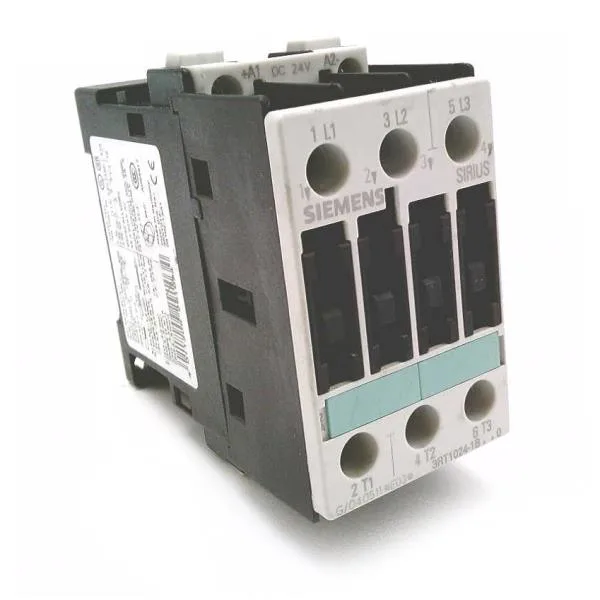
The Siemens SIRIUS 3RT1024-3XP00-0GA0 is a power contactor in the S0 frame size, rated to switch motor loads up to 7.5 kW at both 500 V and 690 V. It carries a varistor surge suppressor built in, so you don't need to add a separate RC snubber across the coil for inductive load damping. Side-by-side mounting is allowed — no mandatory gap between units — which keeps panel density high.
The headline 7.5 kW rating at 500 V and 690 V tells you this contactor is sized for a 7.5 kW three-phase induction motor on a 500 V or 690 V line. For the heavier AC-4 duty (plugging, inching, reversing), the rating drops to 12.5 A at 400 V — roughly 5.5 kW equivalent — so if your application cycles the contactor under full locked-rotor current, the AC-4 figure governs the selection, not the AC-3 number. The coil operates at 50 Hz with a voltage tolerance of 0.8 to 1.1 times the rated value — meaning a 230 V coil holds in from about 184 V to 253 V. That's a standard ±20% band, typical for industrial control transformers. The varistor suppressor clamps the turn-off spike, which extends the life of the coil and reduces EMI on the control wiring.
Lifecycle and sourcing reality — current production, no LTB
If you're comparing against the 3RT1023-1AL20 — a smaller S0 variant with a lower current rating — the 3RT1024-3XP00-0GA0 carries the higher 7.5 kW output and the varistor suppressor already fitted. The 3RT1023-1AL20 omits the varistor and tops out at a lower kW, so this unit is the drop-in upgrade if your motor load grew or you want the integrated suppression without adding a separate module.
Integration notes — panel fit and wiring
The S0 frame measures 45 mm wide, 119 mm high, 100 mm deep. That depth includes the coil and arc chamber — verify clearance to the enclosure door or busbar shroud. The screw terminals accept 2x (0.25 to 2.5 mm²) solid or stranded, or 2x (2.5 to 6 mm²), or a single 10 mm² conductor. For AWG, that's 2x (16 to 12) or 2x (14 to 10) or 1x 8 AWG. Strip length and torque values are standard for the S0 terminal block — no special tooling needed.