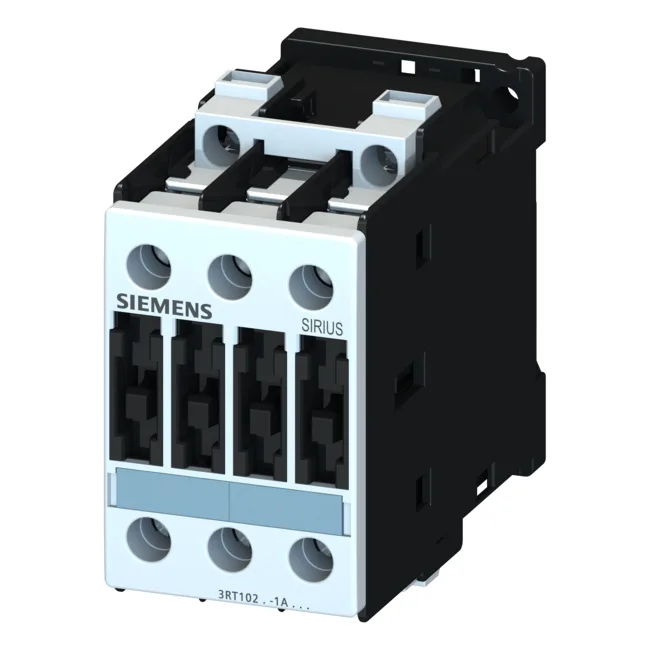
What this SIRIUS S0 contactor carries
Its AC-2 rating at 400 V delivers 7.5 kW — that's the duty cycle for slip-ring motors or wound-rotor applications where starting current stays moderate. The 45 mm width and 85 mm height keep it tight for multi-contactor groups; depth runs 91 mm, which matters when the enclosure backplate-to-door clearance is tight. Coordination flexibility is built in: with type 2 coordination (no weld-stick after a fault) the required upstream fuse is 25 A gL/gG; with type 1 coordination (device may be damaged but clears the fault) it accepts up to 63 A gL/gG. That gives the panel designer a choice between tighter protection or higher fault-clearing capacity depending on the branch circuit.
Main current circuit terminals are screw-type, accepting solid or stranded conductors: 2x (0.5 to 1.5 mm²), 2x (0.75 to 2.5 mm²), and max 2x (0.75 to 4 mm²). For AWG, that translates to 2x (16 to 12), 2x (14 to 10), and 1x 8. The auxiliary contact block (if fitted) shares the same terminal style — no special crimp tooling needed beyond standard screwdriver-termination practice.
Coil and control circuit ratings
The coil operates across 0.8 to 1.1 times the rated voltage at both 50 Hz and 60 Hz, giving a pickup range that handles typical line sag without nuisance dropout. Rated control supply voltages are 110 V at 50 Hz and 120 V at 60 Hz. Switching capacity on the auxiliary contacts covers 10 A at 24 V, 6 A at 230 V, and 3 A at 400 V — enough for direct PLC input drive or small relay loads without an interposing relay.