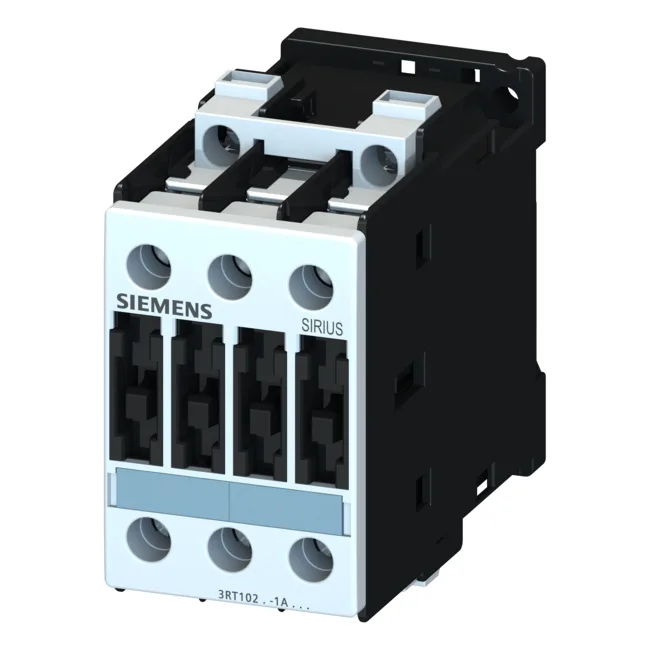
For reversing or plugging duty (AC-4), it carries 15.5 A at 400 V — that's the rating that governs frequent inching or reversing applications where the contacts break full motor current.
Pollution degree 3 (conductive pollution) suits it for industrial environments where occasional condensation or light dust is present. Type 1 coordination requires a 63 A gL/gG fuse upstream; Type 2 coordination needs a 25 A gL/gG fuse. That distinction matters for selectivity: Type 2 leaves the contactor operational after a short-circuit, while Type 1 allows the contactor to be damaged but clears the fault. Pick your fuse per the coordination class your panel design specifies. IP20 on the front protects against finger contact; IP00 at the terminals means the connection area must be inside a closed enclosure. The screw-type terminals on both main and auxiliary circuits accept solid or stranded copper: main terminals take 2x (1 to 2.5 mm²) or up to 2x 10 mm² max, auxiliary terminals take 2x (0.5 to 1.5 mm²) or up to 2x 4 mm² max. That covers most panel wiring from 16 AWG down to 8 AWG for the mains.
Substance prohibition per RoHS applies from 01.07.2006. Verify UL/CSA certification for your jurisdiction at quote.
The 45 mm width and 85 mm height fit the S0 footprint. Depth is 140 mm. Side-by-side mounting is permitted. Coil ratings at other voltages: 2 A at 60 VDC, 1 A at 110 VDC, 0.3 A at 220 VDC, 6 A at 230 VAC, 3 A at 400 VAC. The coil operates on 50 Hz or 60 Hz with a tolerance band of 0.8 to 1.1 times nominal at 50 Hz and 0.85 to 1.1 at 60 Hz. That means the coil pulls in reliably even if the control supply sags to 80% of nominal at 50 Hz.