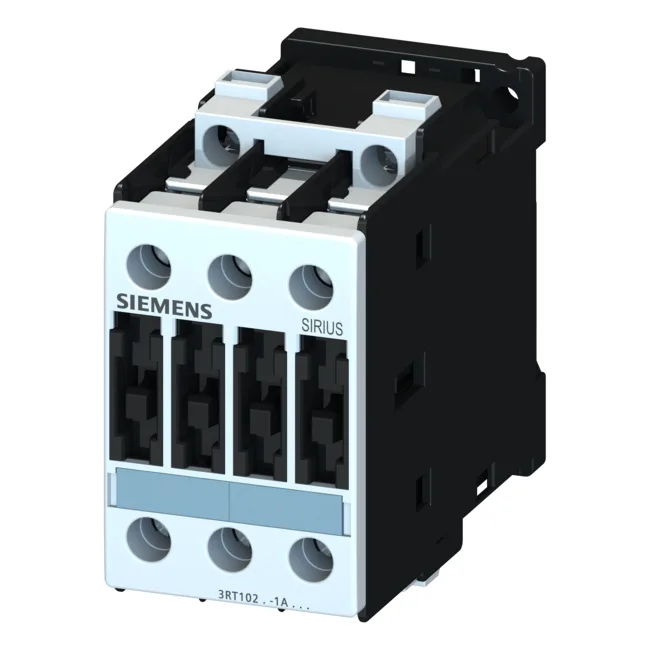
The AC-2 rating of 7.5 kW at 400 V covers wound-rotor motor duty (slip-ring starting), while the AC-4 rating of 15.5 A at 400 V governs plugging and inching applications where the contactor breaks full motor current. For fixed-speed squirrel-cage motors, the AC-3 capability is implicit in the S0 frame; the listed motor ratings of 10 kW at 500 V and 11 kW at 690 V give the upper bound for standard three-phase induction motors on those line voltages. The DC switching table — 10 A at 24 V, 2 A at 60 V, 1 A at 110 V, 0.3 A at 220 V — is the resistive load curve; inductive DC loads need derating or arc suppression.
The 45 mm width (three S0 pole spaces) fits a standard 45 mm module slot in a control panel. Side-by-side mounting is permitted with no derating gap, so a multi-contactor group packs tightly on the rail — useful for a motor control centre row. Screw-type terminals on both main and auxiliary circuits; the main terminals accept 2x (1 … 2.5 mm²) solid or stranded, up to 2x 10 mm² maximum. Auxiliary terminals take 2x (0.5 … 1.5 mm²) solid, up to 2x 4 mm².
Type 2 coordination (contactor remains usable after clearing) needs a 25 A gL/gG fuse. These values guide the upstream protection selection for a motor branch circuit. The mechanical life of 10 million cycles typical means the contactor outlasts most electromechanical loads in normal service; electrical life depends on switching current and load type.