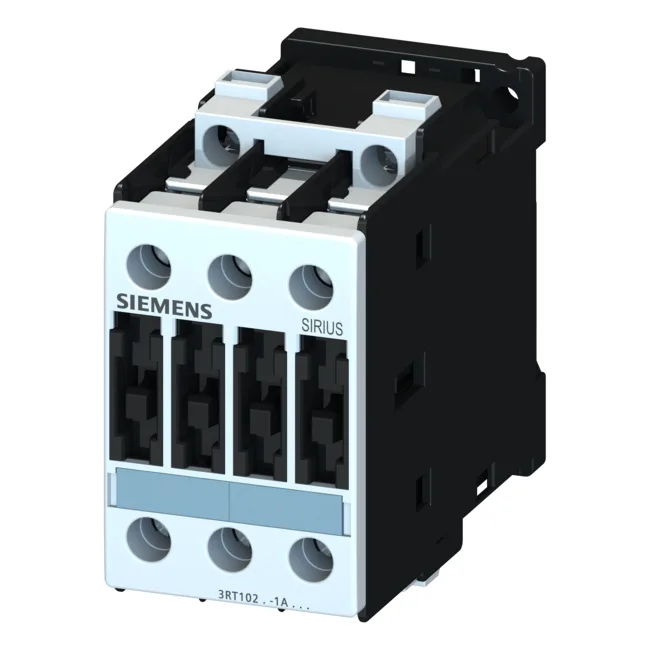
Rated at 7.5 kW in AC-2 duty at 400 V and 11 kW at 690 V, it covers the common European motor voltage range on a 50 Hz supply. The AC-4 rating of 15.5 A at 400 V matters when the contactor must switch motor loads inching or plugging duty, where the contacts make and break full locked-rotor current.
The 7.5 kW AC-2 rating at 400 V defines the motor-switching capacity for slip-ring motors or wound-rotor drives, where the starting current is lower than a standard squirrel-cage start. For a standard squirrel-cage motor (AC-3), the contactor is typically applied at a lower kW; the 11 kW at 690 V AC-3 rating indicates it can handle a 690 V motor up to that output. The IP20 front-of-panel protection means the operator side is finger-safe, while the IP00 terminal area requires the panel enclosure to provide the final touch protection. Type 2 coordination requires a 25 A gL/gG fuse upstream to limit through-fault energy; type 1 coordination allows up to a 63 A gL/gG fuse if the contactor may be replaced after a fault.
Main circuit terminals are screw-type, accepting 2x (1 to 2.5 mm²) stranded or 2x (0.5 to 1.5 mm²) solid, with a maximum of 2x 10 mm² stranded or 2x 4 mm² solid. The 140 mm depth fits standard enclosures with room for wiring ducts; the 85 mm height clears typical contactor rail spacing. Side-by-side mounting is allowed with no derating if the ambient stays within the -25 to +60 °C range and the load current is within the AC-1 or AC-3 thermal limits.