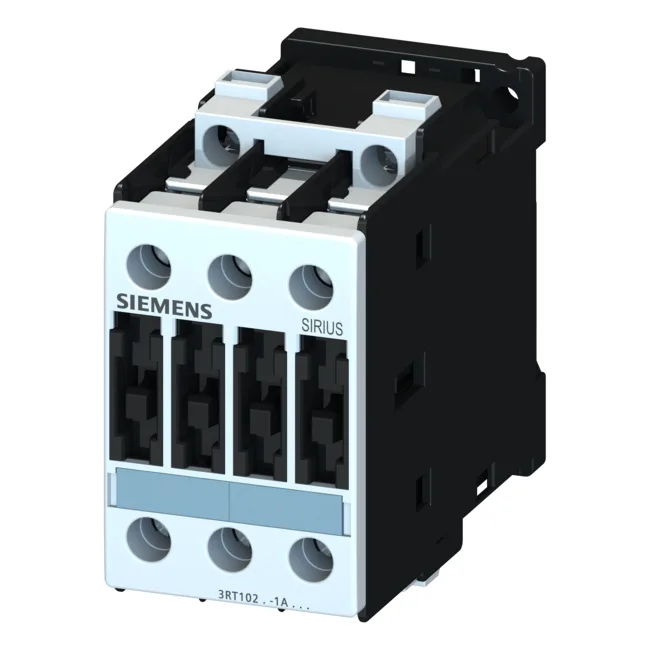
The Siemens 3RT1025-1AP64 is a SIRIUS power contactor in the S0 frame size, rated for motor switching up to 11 kW at 690 V AC-3 and 10 kW at 500 V AC-3 — that's the duty cycle for starting and running squirrel-cage induction motors under normal load. For reversing or plugging duty (AC-4), it's rated 15.5 A at 400 V, which is the current it can interrupt during inching or counter-torque stops. The contactor carries a mechanical life of 10 million operations, so it's sized for high-cycle applications like conveyor lines or pump stations where the panel builder needs the S0 footprint (45 mm wide, 85 mm tall, 140 mm deep) to fit a dense DIN-rail layout.
Mounting and integration — DIN-rail and terminal details
The main circuit uses screw-type terminals accepting 2x (1... 2.5 mm²) solid/stranded, 2x (2.5... 6 mm²), or max 2x 10 mm²; auxiliary and control circuit terminals accept 2x (0.5... 1.5 mm²), 2x (0.75... 2.5 mm²), or max 2x (0.75... 4 mm²). AWG equivalents: main contacts 2x (16... 12), 2x (14... 10), 1x 8; auxiliary contacts 2x (20... 16), 2x (18... 14), 1x 12. IP20 on the front, IP00 at the terminals — so the terminal area needs enclosure protection if washdown or dust ingress is a concern.
Coordination and protection — fuse sizing for Type 1 and Type 2
These are the values the panel designer needs for the SCCR calculation upstream — the 25 A Type 2 limit is the tighter constraint and governs the branch circuit protection if you want to avoid replacing the contactor after a fault.
Auxiliary contact ratings and ambient limits
Auxiliary contacts rated 10 A at 24 V, 6 A at 230 V, 3 A at 400 V, 2 A at 60 V, 1 A at 110 V, 0.3 A at 220 V — these are the making/breaking capacities for the control circuit, not the main power path.