What it is and where it lands
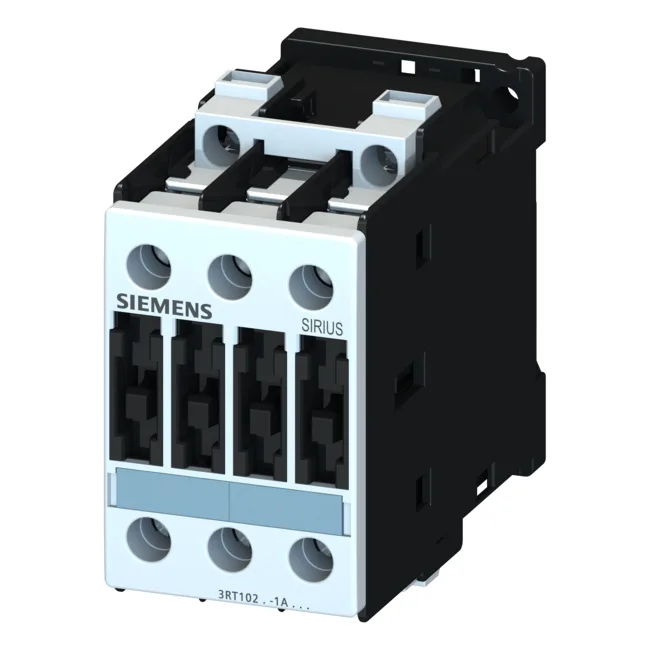
The Siemens 3RT1025-1BE44 is a SIRIUS power contactor in the S0 frame size, designed for switching motor loads in control panels. It mounts on a 35 mm DIN rail per EN 50022, with screw and snap-on fastening, and occupies a 45 mm wide footprint — standard for a three-pole contactor in this class. The 24 VDC coil draws 5.4 W during both closing and holding, so the control transformer or DC supply needs to sustain that steady load without a drop-out margin. Rated operating range on the coil is 0.8 to 1.1 times the rated value, meaning the coil holds in from about 19.2 V to 26.4 V DC. For motor duty, the contactor is rated 7.5 kW at 400 V in AC-2 (slip-ring motor starting) and 15.5 A at 400 V in AC-4 (plugging/inching). That AC-4 figure governs the real-world life when the contactor sees frequent reversing or jogging — the AC-2 rating is for less demanding starts.
Mounting and wiring in the panel
The contactor is 85 mm tall and 150 mm deep. Side-by-side mounting is permitted without derating. Main circuit terminals accept solid conductors from 2x (0.5 to 1.5 mm²) up to max 2x (0.75 to 4 mm²), or stranded from 2x (1 to 2.5 mm²) up to max 2x 10 mm². Auxiliary terminals take 2x (0.5 to 1.5 mm²) solid or 2x (0.75 to 2.5 mm²) stranded. That covers most panel wiring up to 4 mm² for power and 1.5 mm² for control. The front face carries an IP20 rating — safe for finger contact during troubleshooting. The terminal area is IP00, so live parts are exposed when the cover is off; standard panel guarding applies.
Short-circuit coordination and ambient limits
For Type 2 coordination (no damage to the contactor after a fault), the required upstream fuse is gL/gG 25 A. For Type 1 coordination (contactor may need replacement after a fault), use a 63 A gL/gG fuse. This matters when specifying the branch circuit protection in a UL or IEC panel. Ambient operating temperature range is -25 to +60 °C, with pollution degree 3 (conductive pollution or dry non-conductive that becomes conductive). That suits industrial environments with dust, oil mist, or condensation — typical for conveyor zones or machine tool cells.
