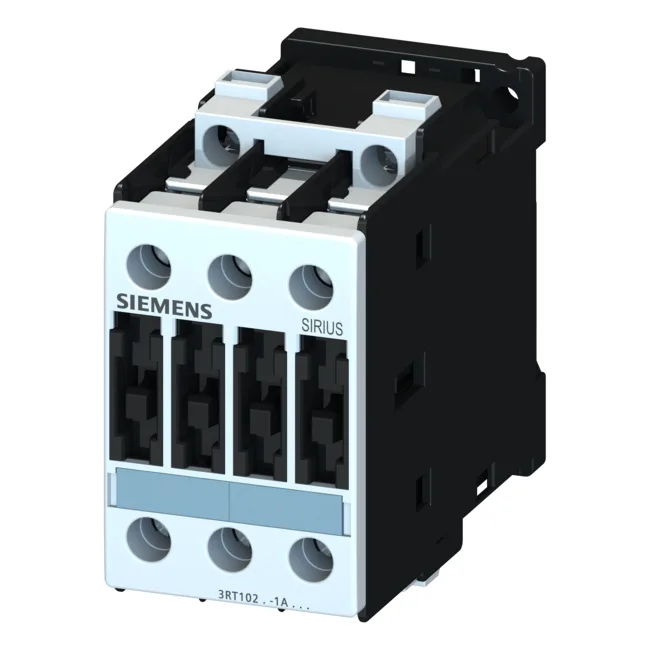
The Siemens SIRIUS 3RT1025-1BF44 is a size S0 power contactor rated for 7.5 kW at AC-2 duty on a 400 V supply, with a 110 VDC coil. It mounts on a 35 mm DIN rail per EN 50022, using either the integrated snap-on feature or screws, and occupies a 45 mm wide slot in the panel. The AC-2 rating (7.5 kW at 400 V) tells you this contactor is sized for slip-ring motor loads where starting current is moderate and switching frequency is regular — typical for crane drives, hoists, or conveyor systems that cycle under load. The AC-4 rating (15.5 A at 400 V) covers plugging and inching duty for the same motor frame, so it handles the high-stress reversals without derating prematurely. Front-side protection is IP20, which is standard for enclosed panel mounting; the terminals themselves carry an IP00 rating, meaning the wiring compartment expects to be inside a cabinet or shrouded. The coil draws 5.4 W for both closing and holding — a DC magnet that doesn't switch to a lower hold power, so factor that into your 24 VDC supply budget if you're running several contactors.
Mounting and integration
Snaps onto standard 35 mm DIN rail per DIN EN 50022, or can be screw-mounted directly to the backplate. Side-by-side mounting is permitted with zero clearance — the 6 mm side spacing is the minimum for heat dissipation, not a mandatory gap. The S0 frame keeps the height at 85 mm and depth at 150 mm, so it fits most 200 mm deep enclosures without crowding the door. Main circuit terminals accept screw-type connections: solid conductors up to 2x 4 mm², stranded up to 2x 6 mm², or a single 10 mm². Auxiliary contacts (2 N.O. instantaneous) use the smaller 0.5–2.5 mm² range. For North American builds, the AWG equivalents are 2x 16–12 for the aux and 2x 14–10 for the mains, with a single 8 AWG allowed.
Coordination and protection
For Type 2 coordination (no damage to the contactor after a short circuit), Siemens specifies a gL/gG fuse rated at 25 A. Type 1 coordination (contactor may need replacement after fault) allows a 63 A gL/gG fuse. The pollution degree is 3, so it's rated for conductive environments typical of industrial panels — no additional conformal coating needed for normal factory floor conditions.
