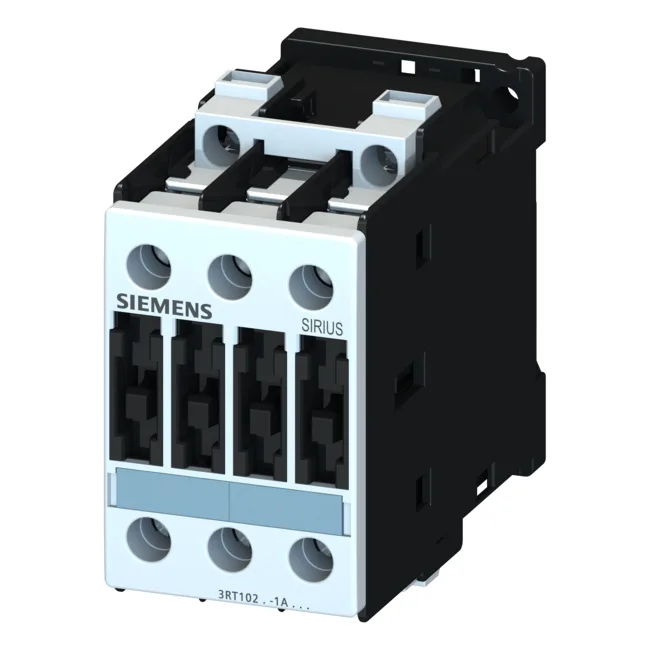
At 500 V it carries 10 kW, and at 400 V in AC-2 duty (slip-ring motors or resistive-inductive mixed loads) it manages 7.5 kW. For high-inrush reversing or plugging duty (AC-4), the rating is 15.5 A at 400 V — a lower figure that governs frequent jogging or inching applications. The DC coil draws 5.4 W on pickup and holds at the same 5.4 W — a continuous-duty solenoid that stays cool in a sealed panel. The IP20 front face protects against finger contact; the terminal area is rated IP00, meaning the wiring compartment expects enclosure protection from the panel.
Coordination and wiring — what the protection specs tell you
For a motor branch circuit, the 25 A fuse is the safer choice — it limits let-through energy and keeps the contactor in service after a fault. Main circuit terminals accept 2x (0.5 to 1.5 mm²) solid, 2x (0.75 to 2.5 mm²) stranded, or up to 2x 4 mm² max. For AWG, that's 2x (16 to 12) solid, 2x (14 to 10) stranded, or 1x 8 AWG. The auxiliary contact block (2 instantaneous contacts) shares the same terminal range. Side-by-side mounting is permitted with 6 mm spacing — no derating required for adjacent units at rated load.