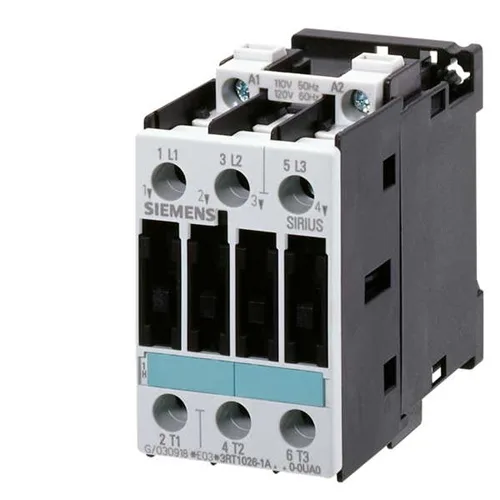
The 230 V AC coil pulls 5.4 W during both closing and holding — no power drop after pickup, which matters when the control transformer is sized tight.
Terminals and wiring
Both main and auxiliary circuits use screw-type terminals. Main terminals accept 2x (1 to 2.5 mm²) solid or stranded, up to 2x 6 mm², max 2x 10 mm². Auxiliary terminals take 2x (0.5 to 1.5 mm²) solid, 2x (0.75 to 2.5 mm²) stranded, max 2x 4 mm². AWG equivalents are listed for both: main 2x (16 to 12), 2x (14 to 10), 1x 8; auxiliary 2x (20 to 16), 2x (18 to 14), 1x 12. That covers most panel wire from 1.5 mm² control circuits up to 10 mm² motor feeds. IP20 on the front face, IP00 at the terminals — standard for an open-panel contactor. The terminal shroud is the panel builder's call if the enclosure IP rating requires it.
Switching capacity and coordination
Rated operational current at AC-12 (resistive) is 10 A maximum. Motor-duty ratings: at AC-2 at 400 V it handles 7.5 kW; at AC-4 at 400 V it carries 15.5 A — that's the reversing or inching duty cycle, where the contactor makes and breaks full load current. At 690 V, the motor rating is 11 kW. For DC switching: 10 A at 24 V, 2 A at 60 V, 1 A at 110 V, 0.3 A at 220 V, 6 A at 230 V, 3 A at 400 V, 10 kW at 500 V. Type 1 coordination requires a 63 A gL/gG fuse upstream; Type 2 coordination calls for 25 A gL/gG. That's the short-circuit protection the contactor needs to stay functional after a fault — spec it into the feeder design, not after.