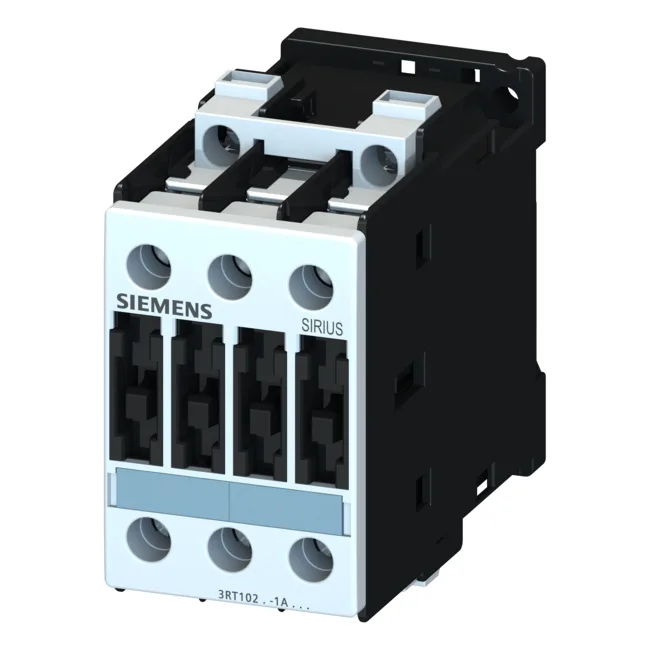
It is a current-production part, so it remains a standard BOM line item for new builds and replacements alike. The built-in varistor surge suppressor protects the coil driver from inductive kickback, so you can skip adding an external flyback diode across the coil terminals. Rated for AC-2 duty at 7.5 kW on 400 V, this contactor handles slip-ring motor starting and reversing loads where the current stays below the make/break stress of AC-3. For plugging or inching duty, the AC-4 rating of 15.5 A at 400 V gives the thermal limit for frequent reversals.
The 45 mm width and 88 mm height fit the S0 footprint, which is the standard for contactors up to about 12 A AC-3. IP20 on the front enclosure protects against finger contact inside the panel; the terminal area is IP00, meaning the wiring compartment is open to the panel environment. This is typical for panel-mounted contactors — the enclosure itself provides the final IP rating.
Main circuit terminals accept screw-clamp connections: 2x 0.5–1.5 mm² solid, 2x 0.75–2.5 mm² solid, or up to 2x 4 mm² solid. The auxiliary/control circuit terminals handle 2x 1–2.5 mm² solid or stranded, up to 2x 6 mm². AWG equivalents are listed for both circuits — main terminals take 2x 16–12 AWG, aux terminals take 2x 20–14 AWG. For Type 1 coordination (welding allowed but no fire risk), use a 63 A gL/gG fuse. These values let you size the branch circuit protection without guesswork.
For a contactor switching once per minute, that's roughly 19 years of continuous service before mechanical wear-out.