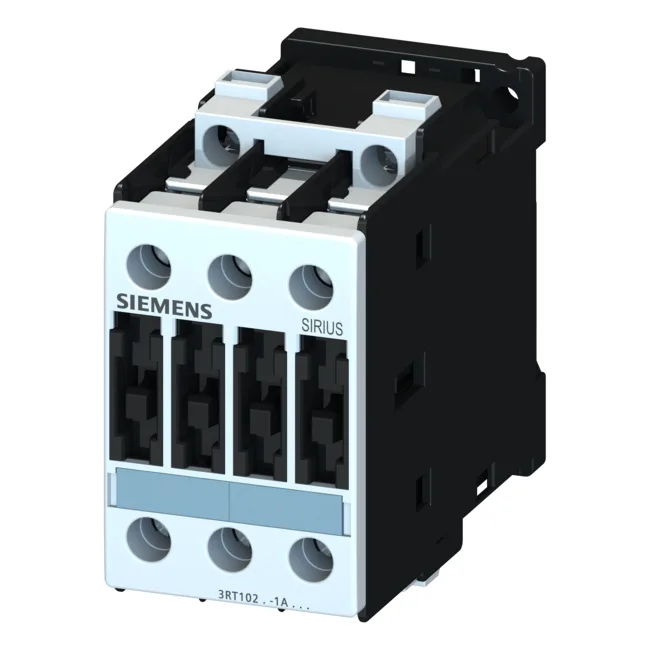
It carries a 24 V DC coil and is rated for 11 kW at 690 V AC (AC-3 duty), meaning it can handle three-phase motors up to that power level in standard starting applications.
The 24 V DC coil pulls 10 A at the rated voltage, which is the inrush holding current you need to budget for in your 24 VDC supply. For DC switching, the contactor handles 10 A at 24 V, 2 A at 60 V, 1 A at 110 V, and 0.3 A at 220 V — these are the resistive DC current limits; derate further for inductive DC loads. On the AC side, the motor ratings span from 3 hp at 230 V to 15 hp at 575/600 V, and 11 kW at 690 V. The AC-4 rating at 400 V is 15.5 A — that's the reversing or inching duty current, which is lower than the AC-3 rating because of the higher switching frequency and electrical wear. The impulse withstand voltage is 6 kV, which covers standard industrial surge environments.
The S0 frame is 45 mm wide, 116 mm tall, and 150 mm deep, so it fits a standard 45 mm slot on the rail. Side-by-side mounting is permitted with zero clearance between units, which saves rail space in dense panels. Clearance to grounded parts: 10 mm upwards, forwards, downwards, and to the sides — plan your gland plate and wireway accordingly. The main circuit uses screw-type terminals accepting 2x 1–2.5 mm², 2x 2.5–6 mm², or max 2x 10 mm² stranded. The coil/auxiliary terminals accept 2x 0.5–1.5 mm², 2x 0.75–2.5 mm², or max 2x 0.75–4 mm² solid. IP20 on the front, IP00 at the terminals — so the terminal area needs finger-safe covers or enclosure protection in the final panel.