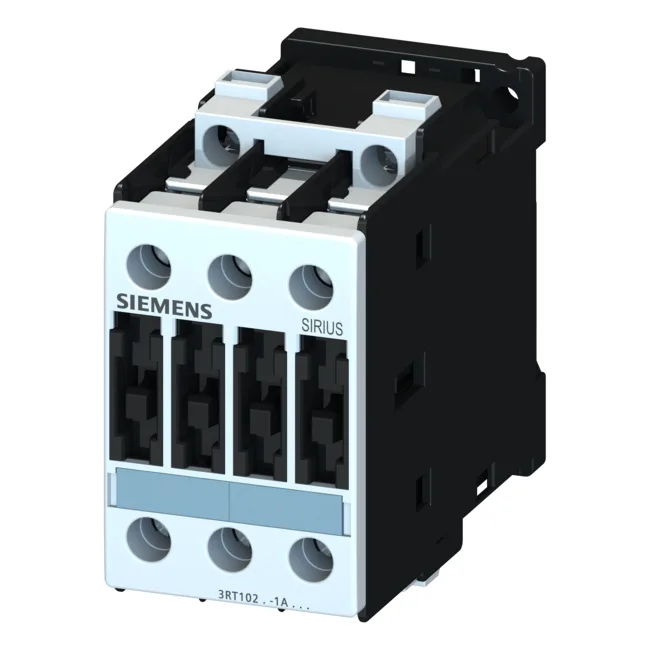
The Siemens SIRIUS 3RT1025-3AG20-ZW98 is an S0-frame power contactor rated for motor switching at 7.5 kW under AC-2 duty at 400 V — that is the rating that governs starting and stopping wound-rotor or slip-ring motors where the load current stays below the locked-rotor value. For inching or plugging duty (AC-4) at the same voltage it carries 15.5 A, so if your application reverses or jogs the motor under full load, this is the number that decides thermal margin, not the AC-2 figure. Front-face protection is IP20, meaning the live terminals are touch-safe from the front once the contactor is mounted; the connection points themselves are IP00, so clearance to grounded metal inside the panel must follow the usual IEC 60947-1 rules.
The SIRIUS S0 platform is a mature, widely stocked family, so cross-shipments from multiple distribution legs are typical for urgent needs. No official successor has been announced because the design is still active.
That sets the minimum creepage distances inside the enclosure; if your panel is in a clean, climate-controlled room you have margin, but if it goes into a washdown area or an unheated shed, the PD3 rating is what keeps the contactor from tracking across the surface. Above 40 °C the coil and main contacts need derating per the manufacturer's thermal curve — the spec table's current values are at 40 °C unless otherwise noted. For Type 1 coordination (the contactor may need replacement after the fault) the limit is 63 A gL/gG. If your upstream protection is a MCCB rather than fuses, verify the let-through energy against the contactor's withstand curve.
DC switching and auxiliary ratings
The auxiliary contact block (not included with this base unit) switches DC loads: 10 A at 24 V, 2 A at 60 V, 1 A at 110 V, 0.3 A at 220 V. These are resistive (DC-1) values; inductive loads like DC brake coils need a free-wheeling diode across the load or the contact life drops sharply. Under full AC-3 or AC-4 load the electrical life will be lower; the exact figure depends on the switching frequency and the actual current.