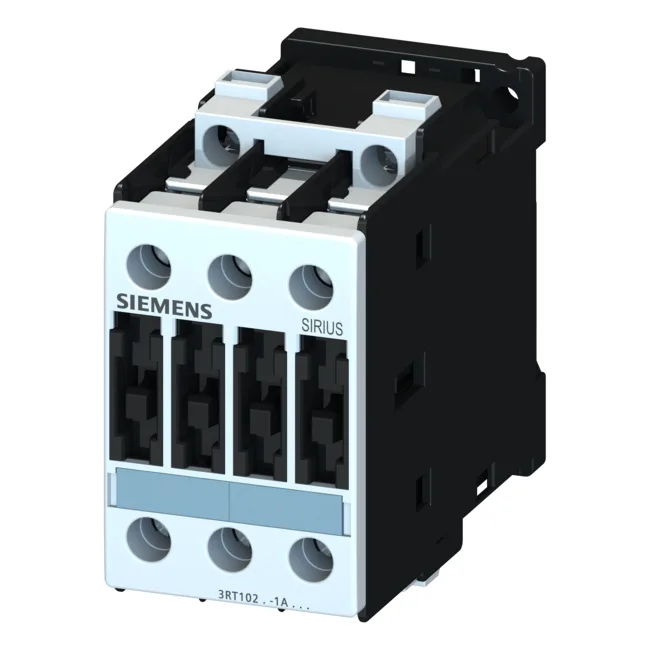
Its headline rating of 11 kW at 690 V AC-3 tells you the motor it can handle under standard three-phase induction duty — that's roughly a 15 hp motor at 480 V. For reversing or inching duty (AC-4), the continuous current limit drops to 15.5 A at 400 V — a real constraint if your cycle count is high. The coil pull-in range is 0.8 to 1.1 x rated voltage at 50 Hz, 0.85 to 1.1 at 60 Hz, so it holds in on a sagging line but drops out cleanly below that. The S0 frame at 45 mm wide and 90 mm deep fits a standard panel grid without surprises.
Terminal and wiring — screw-type, solid and stranded
Main current circuit terminals are screw-type, accepting solid conductors 2x (0.25 to 2.5 mm²) and stranded 2x (1 to 2.5 mm²) with a maximum of 2x 10 mm². AWG equivalents are 2x (16 to 12) solid, 2x (14 to 10) stranded. The auxiliary contact block is rated at 10 A for AC-12 resistive loads at 24 V, with lower current ratings for higher voltages (2 A at 60 V, 1 A at 110 V, 0.3 A at 220 V). For the main power circuit, the contactor's own thermal current is not explicitly listed, but the AC-3 rating at 400 V (10 kW) and 690 V (11 kW) gives the real-world motor-switching capability. That's a useful selectivity number for the panel designer.
The front face is rated IP20 (finger-safe), the terminal area is IP00 (open). Side-by-side mounting is allowed, but keep the 6 mm gap for thermal management — the datasheet's derating curve assumes that spacing.