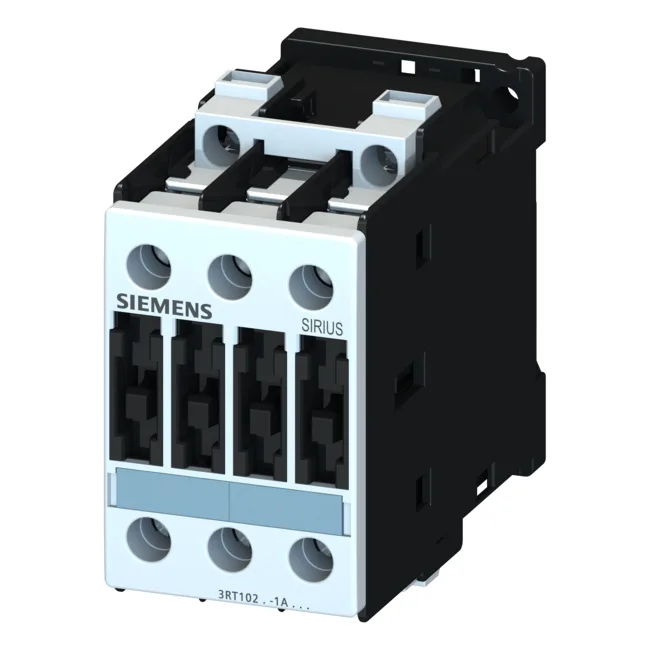
This contactor is rated for motor duty: 7.5 kW at AC-2 (400 V) and 15.5 A at AC-4 (400 V). AC-2 covers slip-ring motor starting and reversing; AC-4 covers plugging and inching — the harder duty cycle. If you're switching a standard squirrel-cage motor on a pump or conveyor, those are the numbers that tell you whether it'll hold up. At 500 V it's good for 10 kW and at 690 V for 11 kW, so it spans common European voltage levels without derating surprises. The coil is a straight 110 V DC, pulling 4.2 W on both pick-up and hold. That constant-power coil means the control transformer or DC supply doesn't see a current spike on closure — useful when you're driving several contactors from one supply. The varistor across the coil clips the inductive kickback, which protects nearby PLC outputs and keeps the panel quiet. Mechanically, it's rated for 10 million typical operations, which is a long service life for a contactor this size.
Side-by-side mounting is allowed, which keeps the panel dense. The main circuit terminals accept solid or stranded wire: 2x (0.25 to 2.5 mm²) for the control circuit, and up to 2x 10 mm² or 1x 8 AWG for the power circuit. That's enough for the motor leads on a 7.5 kW load at 400 V. The front of the contactor is IP20 — safe to touch with tools — but the terminals are IP00, so live parts are exposed once the wire is landed. That's standard for panel-mount contactors; just means the panel door needs to be interlocked or the contactor placed behind a cover. That lets you choose between tighter protection or higher fault tolerance depending on the application.