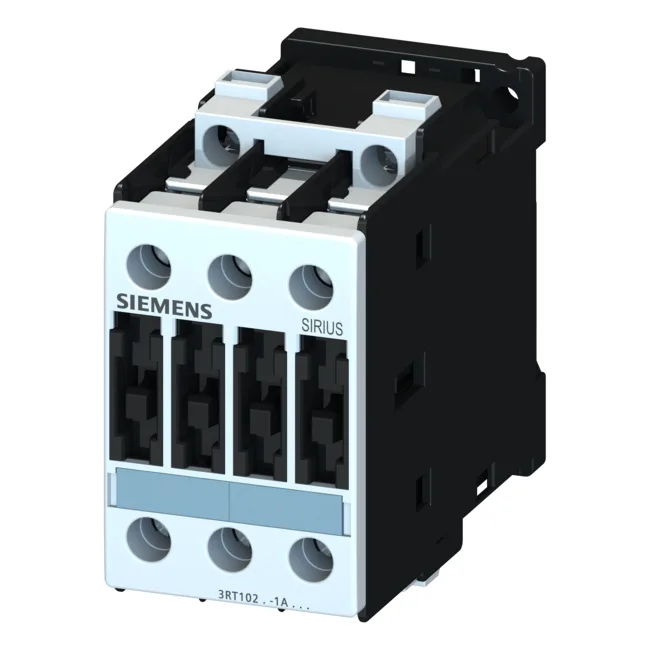
Rated for AC-4 duty at 15.5 A and 400 V, this contactor handles the tough reversing and inching jobs that eat standard contactors alive — plugging, jogging, and frequent starts where the arc hangs around longer than a normal motor start.
Screw-type terminals on the main circuit accept 2x (0.5…1.5 mm²), 2x (0.75…2.5 mm²), or max 2x (0.75…4 mm²) solid wire. That covers most motor and control wiring you'll see on a 10 A to 15 A circuit. The AWG equivalents are 2x (16…12), 2x (14…10), or 1x 8. IP20 on the front, IP00 at the terminals — the contactor is protected against finger contact on the front face but needs enclosure protection (like the panel itself) around the wiring points.
Motor switching performance
In AC-3 standard squirrel-cage motor start/stop, same 11 kW at 400 V. At 690 V, it still handles 11 kW in AC-3, so it works on 690 V systems without stepping down a frame size. For DC switching, the ratings are: 10 A at 24 V, 2 A at 60 V, 1 A at 110 V, 0.3 A at 220 V. That covers DC coil circuits and small DC motor loads. Type 2 coordination (the stricter standard for minimal contact damage) calls for a 35 A gL/gG fuse upstream. Type 1 coordination (allows contactor replacement after a fault) can use a 100 A gL/gG fuse.
Environmental and service conditions
Storage temperature is wider — the handling limit, not the running limit. Above that, you'd need to account for reduced air density on arc extinction.