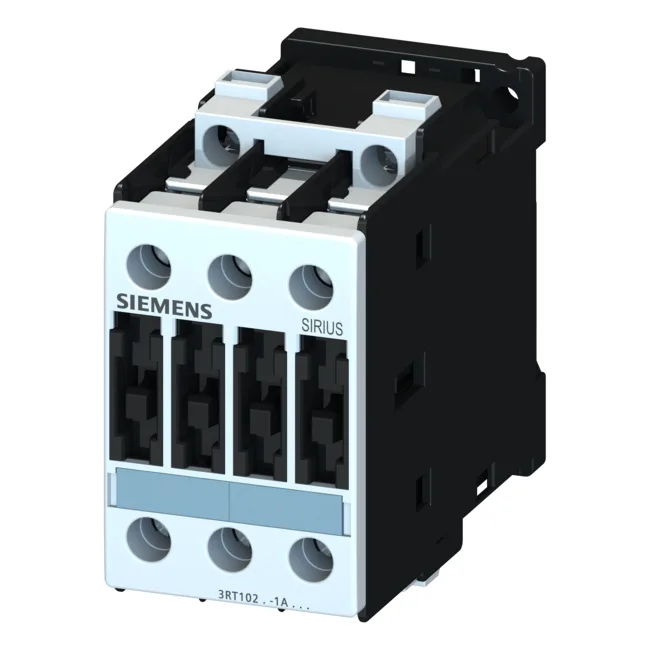
Rated for AC-2 duty at 400 V, it handles 11 kW motor loads, and at AC-4 at 400 V it is rated for 15.5 A — the AC-4 figure governs reversing or inching applications where the contactor makes and breaks the motor at full load. For resistive loads under AC-12, the maximum operating current is 10 A. The coil pulls in at 24 VAC 50 Hz, with an operating range of 0.8 to 1.1 times the rated voltage — so it holds in down to about 19.2 V and picks up reliably at 26.4 V. That range matters when the control transformer is shared with other loads.
Front protection is IP20, meaning the contactor is finger-safe when installed in an enclosure. The terminals themselves are rated IP00, so the live parts are exposed until the panel door is closed — standard for panel-mount contactors. Wire sizes: solid conductors accept 2x 0.5–1.5 mm², 2x 0.75–2.5 mm², or up to 2x 4 mm². Stranded conductors take 2x 1–2.5 mm², 2x 2.5–6 mm², or up to 2x 10 mm². AWG equivalents for the main contacts are 2x 16–12, 2x 14–10, or 1x 8.
No broker or surplus channel is needed for this code.
Auxiliary contacts and protection
The contactor carries two instantaneous auxiliary contacts — one NO and one NC — rated for switching at various control voltages: 10 A at 24 V, 2 A at 60 V, 1 A at 110 V, 0.3 A at 220 V, 6 A at 230 V, and 3 A at 400 V. For short-circuit protection, coordination type 2 requires a gL/gG fuse rated at 35 A; type 1 coordination allows up to 100 A.