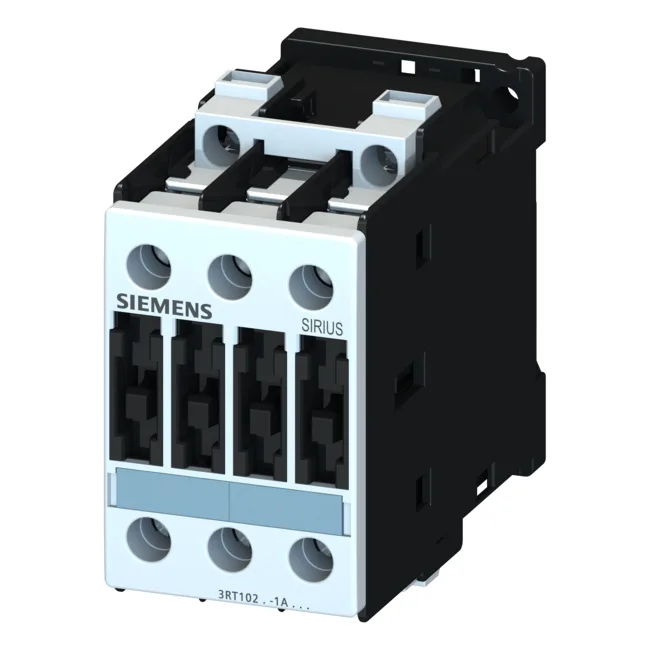
Its headline motor rating is 11 kW at AC-2 duty at 400 V, which covers standard slip-ring motor and moderate-load applications where the switching frequency is not extreme.
The 91 mm depth is the dimension to check against gland-plate clearance or enclosure depth when the panel door has a deep operator device. The front of the contactor carries an IP20 finger-safe rating, meaning the terminals are touch-protected once wired. The terminal itself is rated IP00, so the wiring compartment is open — standard for a panel-mounted device where the enclosure provides the overall protection.
Termination and wiring
Main circuit connections are screw-type terminals. The solid conductor range is 2x (0.5 to 1.5 mm²) or 2x (0.75 to 2.5 mm²), with a maximum of 2x (0.75 to 4 mm²). For stranded or multi-stranded wire, the range is 2x (1 to 2.5 mm²) or 2x (2.5 to 6 mm²), max 2x 10 mm². AWG equivalents are 2x (16 to 12) or 2x (14 to 10), with a single 8 AWG allowed. That covers most panel wiring from control-circuit tails up to motor feeders for the 11 kW rating.
Environmental and operating limits
Pollution degree 3 means it is rated for conductive pollution typical in control rooms and light industrial floors — not for wet or heavily contaminated environments.
For Type 2 coordination (limited damage under short circuit), the required upstream fuse is gL/gG 35 A. For Type 1 coordination (no damage to the enclosure but the contactor may need replacement), the fuse can be up to gL/gG 100 A. This gives the panel designer a clear choice: use the 35 A fuse for higher selectivity and reuse, or the 100 A fuse for simpler coordination if the contactor is considered sacrificial.