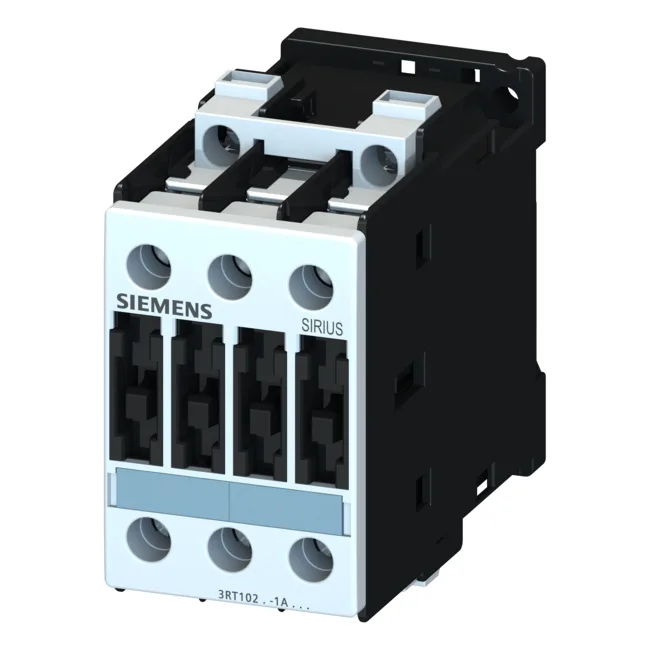
The 24 VAC coil accepts both 50 Hz and 60 Hz supplies, with a rated control supply voltage of 24 V at 50 Hz and 24 V at 60 Hz.
The headline motor rating is 11 kW at 400 V AC-3 and 11 kW at 690 V AC-3. AC-3 is the standard duty for squirrel-cage induction motors — starting and switching off under load. The 11 kW at 400 V means this contactor handles a typical 15 HP (11 kW) motor on a 400 V three-phase supply. For reversing or plugging duty (AC-4), the rated operating current is 15.5 A at 400 V, which is lower than the AC-3 current — AC-4 involves inrush on every operation and the contactor must be derated accordingly.
Auxiliary contact switching capacity
The built-in auxiliary contacts are rated for 10 A at 24 V, 2 A at 60 V, 1 A at 110 V, and 0.3 A at 220 V. These are DC ratings for the auxiliary circuit — useful for signalling to a PLC or relay. The AC rating at 230 V is 6 A, and at 400 V is 3 A. The 10 A maximum operating current at AC-12 (resistive) confirms the auxiliary contacts can handle control transformer loads without issue.
Short-circuit protection and coordination
For Type 2 coordination (contactor remains fully functional after a fault), the required fuse is 35 A gL/gG. These values matter when designing the upstream protection — a 35 A fuse limits let-through energy enough to keep the contactor reusable after a short circuit.
Physical fit and terminal details
The contactor measures 45 mm wide, 85 mm high, and 91 mm deep — a standard S0 footprint that occupies three 18 mm module positions on a DIN rail. Main circuit terminals accept screw-type connections: 2x (0.5...1.5 mm²), 2x (0.75...2.5 mm²), or max. 2x (0.75...4 mm²) for solid wire, and 2x (1...2.5 mm²) or 2x (2.5...6 mm²) for stranded, with a maximum of 2x 10 mm². Auxiliary and control terminals accept 2x (0.5...1.5 mm²) solid or 2x (0.75...2.5 mm²) stranded. The front face is rated IP20, the terminal area is IP00 — meaning the terminals are touch-hazardous and must be inside a closed panel.