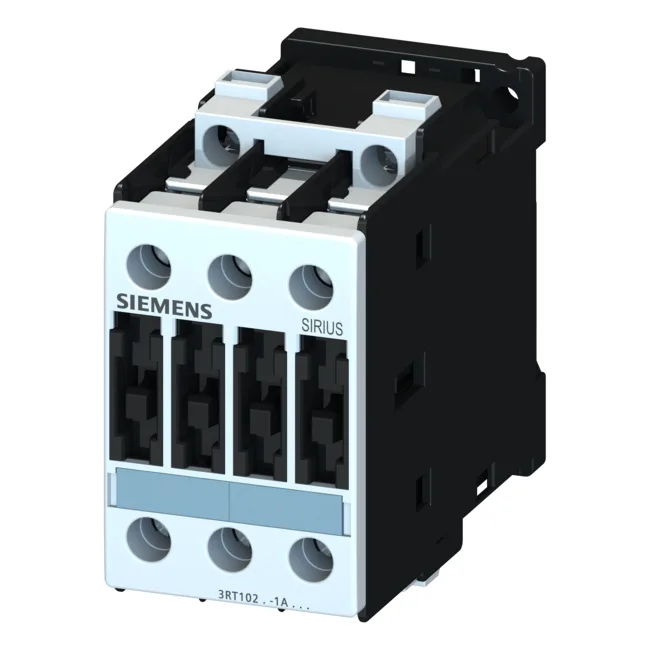
The coil is rated for 24 V at both 50 Hz and 60 Hz, with an operating voltage range of 0.8 to 1.1 times rated at 50 Hz and 0.85 to 1.1 at 60 Hz. This gives you a pickup window of roughly 19.2 to 26.4 VDC-equivalent on the AC coil — useful when the control transformer is shared with other loads.
At 400 V AC-2 duty (starting and running slip-ring motors or moderate loads), this contactor is rated for 11 kW. That same 11 kW rating holds at 500 V and 690 V, meaning the contactor's thermal capacity saturates at the 11 kW level — you don't gain headroom by stepping up voltage beyond 500 V. For AC-4 duty (plugging, inching, reversing) at 400 V, the rated operating current is 15.5 A, which is the figure to use for high-stress switching applications. For resistive loads (AC-12), the maximum continuous current is 10 A. The auxiliary contact ratings span 10 A at 24 V down to 0.3 A at 220 V — typical for a standard contactor block, but verify your control circuit voltage against the curve if you are switching inductive loads like small relays.
Coordination and protection requirements
These are the values to plug into your short-circuit study — not the motor FLA.
Environmental and installation constraints
The front face is IP20 protected; the terminals themselves are IP00, so they require enclosure protection in washdown or dusty environments.
Main current circuit uses screw-type terminals accepting 2x (1 to 2.5 mm²), 2x (2.5 to 6 mm²), or max 2x 10 mm² stranded, or 2x (16 to 12), 2x (14 to 10), or 1x 8 AWG. Auxiliary contacts accept 2x (0.5 to 1.5 mm²), 2x (0.75 to 2.5 mm²), or max 2x (0.75 to 4 mm²) solid. Strip lengths follow standard Siemens practice — no special tooling required.