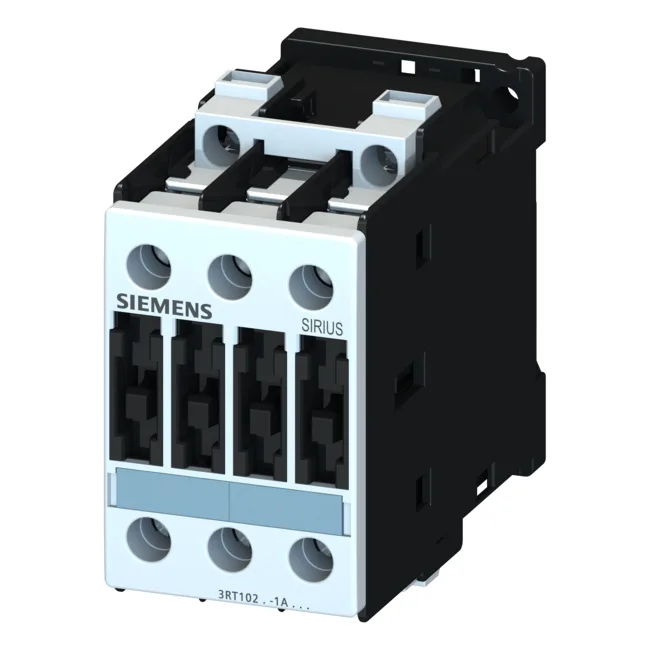
The key motor ratings: 11 kW at 400 V in AC-2 duty (slip-ring motors, moderate switching), and 15.5 A at 400 V in AC-4 duty (reversing, inching, plugging — the heavy stuff). For AC-12 resistive loads, it handles 10 A.
Side-by-side mounting is permitted with zero clearance — the 6 mm side spacing is for air circulation, not mandatory gap. Front protection is IP20, terminals are IP00, so the panel enclosure provides the environmental seal. Main circuit terminals are screw-type, accepting 2x (1... 2.5 mm²) or 2x (2.5... 6 mm²) stranded, or 2x (0.5... 1.5 mm²) solid. AWG equivalents: 2x (16... 12) and 2x (14... 10). The auxiliary contact block has 2 instantaneous contacts, rated at 10 A at 24 V, down to 0.3 A at 220 V.
For Type 2 coordination (contactor remains usable after a fault), the fuse drops to gL/gG: 35 A. This matters for panel selectivity studies — if the line feeds multiple starters, the 35 A limit keeps the contactor in service after a downstream fault.