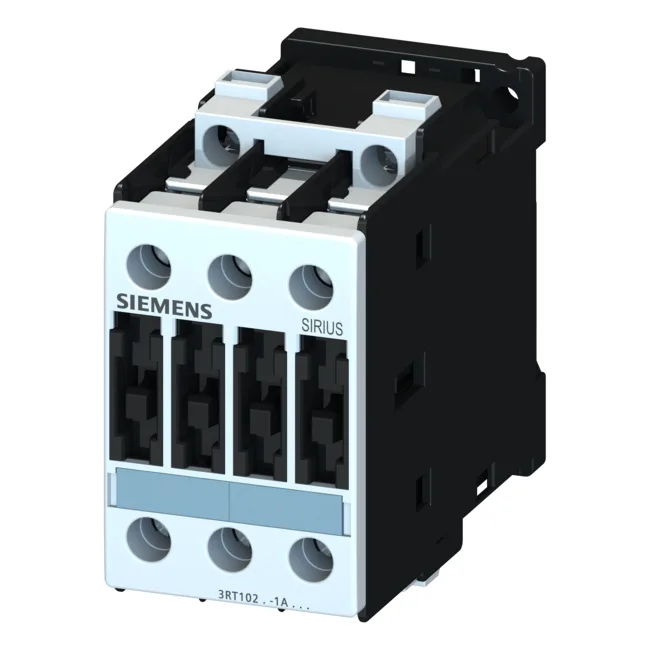
Panel fit and mounting
The 3RT1026-1AH00 is a SIRIUS S0-frame power contactor that mounts via screw or snap-on onto a 35 mm DIN rail per EN 50022. At 45 mm wide and 91 mm deep, it fits a standard 45 mm slot on the rail — no overhang past the mounting foot. Side-by-side mounting is allowed, so you can gang multiple S0 contactors without a gap, but watch the 6 mm clearance to grounded sheet metal at the side. The front face carries an IP20 rating — fingersafe for panel access. The terminal area itself is IP00, meaning the wiring zone is open to the enclosure environment, so the panel must maintain its own IP rating around the gland plate.
What the ratings mean for the motor load
The headline 11 kW rating at AC-2 400 V is the motor-switching figure for slip-ring or wound-rotor motors — that's the duty class where the contactor makes and breaks the load at full current. For inching or plugging duty (AC-4 at 400 V), the rated operational current drops to 15.5 A, which is the current it can switch repeatedly without welding the contacts. If your application is a standard squirrel-cage motor start/stop (AC-3), the 11 kW figure is conservative; the contactor will handle that load class without issue, but the AC-2 number is the certified one on the nameplate. The main contacts are 3-pole normally open — no NC pole on the main circuit. That's typical for a line contactor where you want fail-safe disconnection on all three phases. The auxiliary contact block is separate (not included), so if you need a mirror contact or early-make signal, you'll add a side-mount block.
Wiring and coordination
Main circuit terminals are screw-type, accepting solid conductors from 0.5 to 4 mm² per clamp (two per terminal), or stranded up to 6 mm². For AWG, that's 16 to 10 AWG per clamp, with a single 8 AWG max. The terminal design is the standard box lug — strip length around 10 mm, torque to the value on the contactor label. For Type 1 coordination (no damage to the contactor but the weld may fail), use a gL/gG fuse rated up to 100 A. For Type 2 coordination (no weld, contactor stays operational after a short circuit), the fuse must be limited to 35 A gL/gG. That's a significant difference — if your panel spec calls for Type 2, the 35 A fuse is mandatory, and the upstream breaker must coordinate with it.
Environmental and lifecycle
The contactor is rated for pollution degree 3, meaning it's suitable for industrial environments with conductive pollution or dry non-conductive pollution that could become conductive. Operating temperature range is -25 to +60 °C, which covers most indoor panel conditions. The maximum operating altitude is 2 000 m without derating.
